
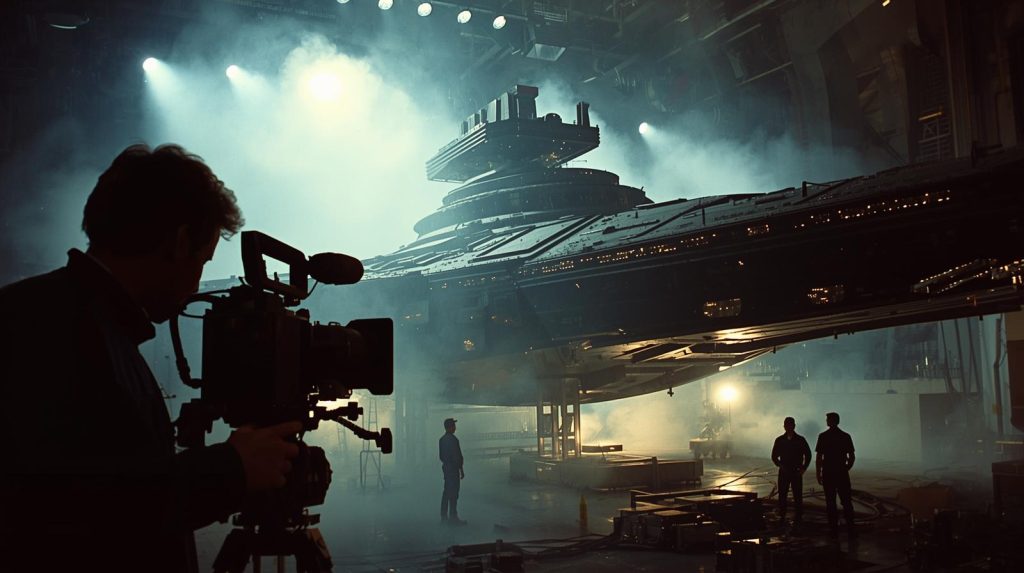

In today’s blockbuster landscape, CGI dominates every frame, from massive space battles to roaring dinosaurs. Studios can now create entire worlds on a computer, making the impossible seem effortless. Yet, for all its digital brilliance, CGI often struggles to capture the weight, texture, and chaotic unpredictability of real objects interacting in physical space. There’s a subtle “uncanny valley” in even the most advanced simulations—something about real gravity, real fluids, and real actors responding to tangible environments that a digital model can’t quite replicate.
This is where practical effects shine. Whether it’s a giant T-Rex thrashing through rain-soaked mud, a spinning spacecraft corridor that bends gravity, or a 320-ton steamship dragged across a mountain, some moments in cinema feel viscerally alive because they existed in the real world. These sequences don’t just look realistic—they behave realistically, responding naturally to air, water, light, and human interaction in ways CGI struggles to emulate.
In this article, we’ll count down 10 groundbreaking practical effects in film history that computers still can’t perfectly replicate. From explosions and animatronics to rotating sets and zero-gravity sequences, these feats of engineering and artistry demonstrate why practical effects remain a crucial tool in a filmmaker’s arsenal. Prepare to explore the ingenuity, danger, and sheer craftsmanship behind moments that digital effects alone could never fully capture.
10. The Trinity Test Explosion – Oppenheimer (2023)
When director Christopher Nolan recreated the Trinity nuclear test for Oppenheimer, he made a striking choice: the explosion would rely almost entirely on practical effects. Special effects supervisor Scott R. Fisher and his team designed a layered sequence of real detonations using gasoline fireballs, propane bursts, magnesium flares, and black powder charges to simulate the stages of a nuclear blast.
Large-scale explosions were filmed alongside miniature desert landscapes that could be blasted apart with compressed air cannons and explosive charges. High-speed cameras captured the rolling turbulence of real flames, while strict safety measures were necessary because every take involved genuine fire, shockwaves, and carefully controlled detonations.
Computer simulations can generate convincing explosions, but the chaotic physics of real fire remain incredibly difficult to reproduce. Real flames interact with oxygen, pressure waves, and surrounding air currents, creating unpredictable shapes and textures that are hard for digital simulations to fully replicate.
Lighting also plays a major role. Real explosions produce intense, irregular illumination that naturally reflects off dust, debris, and nearby surfaces. Practical effects capture this complex light behavior automatically, giving the Trinity test sequence in Oppenheimer a raw authenticity that CGI still struggles to match.
9. In-Camera Forced Perspective – The Lord of the Rings: The Fellowship of the Ring (2001)
To convincingly portray Hobbits as much smaller than humans in The Lord of the Rings: The Fellowship of the Ring (2001), director Peter Jackson relied heavily on in-camera forced perspective rather than digital scaling. Carefully designed sets placed actors playing Hobbits farther from the camera while characters like Gandalf stood closer, creating the illusion of dramatic height differences.
The production also built moving sets and specially sized props that shifted position with the camera to maintain the illusion. Tables, carts, and furniture were constructed at unusual angles, and actors were often positioned several feet apart even though they appeared side-by-side on screen. Every shot required precise camera placement and carefully timed movement to keep the scale believable.
CGI can resize actors digitally, but it often struggles with the subtle physical cues that make size differences feel natural. When performers share a real environment, their eye lines, body language, and interactions with objects naturally align in ways that are difficult to simulate perfectly.
Practical forced perspective also preserves real lighting and depth within the frame. Because everything exists physically on set, shadows, reflections, and spatial relationships behave naturally—something digital compositing can approximate, but rarely replicate with the same effortless realism.
8. The “Polecats” – Mad Max: Fury Road (2015)
One of the most jaw-dropping sights in Mad Max: Fury Road is the group of war boys known as the “Polecats.” These performers swung high above speeding vehicles on enormous flexible poles during the film’s chaotic desert chase sequences. Director George Miller insisted that the stunt be performed practically to give the action a real sense of danger and scale.
The poles, some reaching nearly 20 feet (6 meters) tall were mounted onto moving vehicles and reinforced with steel bases and counterweights. Professional stunt performers balanced at the top while the vehicles raced across the Namibian desert, using harnesses and carefully rehearsed choreography to swing from side to side as if blown by the wind. The effect created towering, human “scarecrows” weaving through the convoy in real time.
A computer could easily generate swinging figures above vehicles, but CGI struggles to recreate the natural physics of flexible poles under real weight and momentum. The subtle bending of the poles, the shifting balance of the performers, and the chaotic movement caused by wind and vehicle speed create complex interactions that are difficult to simulate perfectly.
Just as important is the human element. Because real stunt performers were balancing high above moving trucks, their body movements—micro-adjustments, shifts in balance, and reactions to motion felt authentic. That physical unpredictability gives the Polecat sequence its thrilling realism, something digital doubles rarely replicate with the same intensity.
7. The Chestburster – Alien (1979)
Few moments in film history are as shocking as the infamous chestburster scene in Alien. Director Ridley Scott and special effects artist Roger Dicken created the gruesome effect using a prosthetic torso filled with animal organs, blood packs, and mechanical components.
Actor John Hurt lay beneath the table with his head and arms exposed while the fake chest cavity was rigged with compressed-air devices. When triggered, the alien creature burst violently through the prosthetic ribcage, spraying blood and tissue across the set. Most of the cast were not told exactly how graphic the moment would be, resulting in genuine shock during filming.
CGI can create convincing creatures, but it often struggles to replicate the messy, unpredictable behavior of real fluids and organic materials. The combination of pressurized blood packs, tearing latex, and real organic matter produced a chaotic eruption that feels disturbingly authentic.
Because the effect happened physically in front of the actors, their reactions—flinching, recoiling, and shouting were genuine. That raw human response, combined with the practical splatter and lighting on set, gives the chestburster scene a visceral impact that digital effects rarely achieve.
6. The “Vomit Comet” Weightlessness – Apollo 13 (1995)
To recreate true zero gravity in Apollo 13, director Ron Howard rejected wire rigs and pursued a far more demanding method. The production filmed inside NASA’s KC-135 aircraft nicknamed the “Vomit Comet” creates weightlessness by flying steep parabolic arcs through the sky.
Actors Tom Hanks, Kevin Bacon, and Bill Paxton performed inside a padded spacecraft set installed in the plane. Each parabola created about 25 seconds of real microgravity, forcing the cast and crew to execute movements and dialogue quickly while they floated freely through the cabin.
CGI can imitate floating astronauts, but it struggles to reproduce the subtle physics of real human bodies moving in zero gravity. In genuine microgravity, clothing, hair, and small objects drift naturally and react instantly to the slightest motion.
Because the actors in Apollo 13 actually experienced weightlessness, every movement, from slow spins to drifting tools—followed real physics. That authentic interaction between performers, props, and environment gives the film’s space scenes a realism digital simulations rarely match.
5. Hauling the Steamship Over a Mountain – Fitzcarraldo (1982)
Director Werner Herzog staged one of cinema’s most unbelievable feats in Fitzcarraldo: dragging a real steamship over a jungle mountain. Instead of miniatures or trick photography, Herzog insisted on hauling an actual 320-ton vessel across a steep hill in the Peruvian Amazon.
The crew built a massive pulley system using steel cables, winches, and wooden supports. Hundreds of local workers helped pull the ship uphill inch by inch. The dangerous terrain, heavy machinery, and tropical heat made every step risky. Cameras captured the entire ordeal as the ship slowly climbed the muddy slope.
Digital effects can move enormous objects with ease, but they often struggle to convey true physical weight and resistance. A real ship fighting gravity creates subtle movements, tilts, shifts, and grinding friction that emerge naturally when tons of metal interact with soil and gravity.
The physical effort also shows clearly on screen. Workers strain, cables tighten, and the vessel creeps forward with stubborn momentum. That raw struggle gives the scene its power, something a digital simulation rarely captures with the same convincing heaviness.
4. The Discovery One Centrifuge – 2001: A Space Odyssey (1968)
In 2001: A Space Odyssey, director Stanley Kubrick created the iconic rotating centrifuge to simulate artificial gravity inside the Discovery One spacecraft. The massive set was a 33-foot-long (10-meter) rotating drum, large enough for the actors to walk inside while the set spun around them.
Kubrick and set designer Anthony Masters built the structure with steel and plywood, mounted on a giant circular track. Cameras were carefully rigged to rotate with the drum, giving the illusion that the crew moved normally while centrifugal force pressed them against the floor. The sequence required extreme precision to synchronize rotation, camera movement, and actor choreography.
Computer graphics can spin objects in space, but CGI struggles to reproduce true centrifugal force acting on a human body. In the centrifuge, actors leaned, adjusted their steps, and interacted with props under real physical stress—movements that feel weighty and natural.
Additionally, the set preserved real lighting, shadows, and depth as it rotated. These subtle visual cues, like furniture tilting and light shifting create realism that digital rotations often fail to convey convincingly. The Discovery One centrifuge feels tangible because it physically existed.
3. The Defibrillator / Spider-Head Scene – The Thing (1982)
In The Thing, director John Carpenter delivered one of horror cinema’s most grotesque practical effects: the defibrillator scene with the grotesque “spider-head” transformation. Special effects artist Rob Bottin built a complex animatronic creature with multiple moving parts, including hydraulic limbs, mechanical jaws, and latex skin.
The set combined life-size prosthetics with puppetry and carefully hidden wires. Actors interacted directly with the moving creature, which required precise timing to synchronize the mechanical parts with the actors’ reactions. Some of the prosthetic pieces were filled with realistic fake blood and viscera, adding a tactile, unsettling quality that terrified viewers.
No computer can fully replicate the chaotic organic movement of a real, physical animatronic. The limbs, teeth, and tendrils bend and twist under actual weight, reacting unpredictably to the performer’s touches.
The practical interaction also captures authentic lighting and texture. Shadows fall naturally across rubber, latex, and fluids, creating subtle depth and realism. Digital versions often appear too smooth or uniform, lacking the imperfect, grotesque detail that makes the scene truly horrifying.
2. The Rotating Hallway Fight – Inception (2010)
Christopher Nolan pushed practical effects to the extreme in Inception with the zero-gravity hallway fight. Instead of relying on CGI, the team built a full-scale rotating corridor mounted on a massive gimbal. Stunt performers, including Joseph Gordon-Levitt, trained for weeks to move, run, and fight as the hallway spun around them.
The set rotated slowly while cameras moved with it, creating the illusion of shifting gravity. Choreography required precise timing: one wrong step could injure a performer. Every punch, kick, and fall interacted directly with the physical set, giving each movement a tangible weight and rhythm.
Digital effects could spin a hallway, but they struggle to capture real momentum and inertia on human bodies. Actors adjust their balance, grip, and force in ways that feel natural because they actually respond to rotation.
The rotating set also preserves authentic lighting and spatial perspective. Shadows shift and bounce across walls and performers naturally. CGI often fails to reproduce this subtle interplay, leaving simulated fights slightly flat or artificial compared to the kinetic reality of Nolan’s practical corridor.
1. The Animatronic T-Rex in the Rain – Jurassic Park (1993)
In Jurassic Park, director Steven Spielberg brought dinosaurs to life with practical effects that still awe audiences today. Special effects company Stan Winston Studio built a full-scale, 20-foot-tall animatronic T-Rex weighing over 17,000 pounds. The machine used hydraulics, motors, and silicone skin to create realistic movement, including snarling jaws, blinking eyes, and massive footfalls.
The production filmed the T-Rex during a storm sequence, adding real rain, mud, and splashing water. The combination of a heavy animatronic interacting with physical props and actors, along with controlled lighting and water effects, created a terrifyingly authentic predator that could physically chase characters across the set.
CGI can imitate dinosaurs that move convincingly, but struggles with the organic weight and interaction of a massive creature in wet conditions. The T-Rex’s body compresses mud, drips water, and casts irregular shadows—all of which respond naturally to its size and momentum.
Actors could physically react to the animatronic’s movements, giving scenes genuine tension and fear. The tactile presence, subtle skin flexing, and realistic water behavior make this T-Rex far more convincing than a computer-generated version, proving the enduring power of practical effects.
Will CGI Ever Fully Replace Practical Effects?
Practical effects have repeatedly proven their power to deliver tangible, unpredictable, and utterly convincing moments that CGI alone often cannot replicate. From exploding fireballs in Oppenheimer to a full-scale animatronic T-Rex in Jurassic Park, these effects rely on real physics, weight, and interaction with actors—qualities that digital tools still struggle to reproduce perfectly.
That said, the future of filmmaking isn’t about choosing one over the other. Directors like Christopher Nolan and Denis Villeneuve show how blending practical effects with CGI can create breathtaking, immersive experiences.
Which practical effect from film history blew your mind the most? Did we miss your favorite? Share your thoughts in the comments below!