
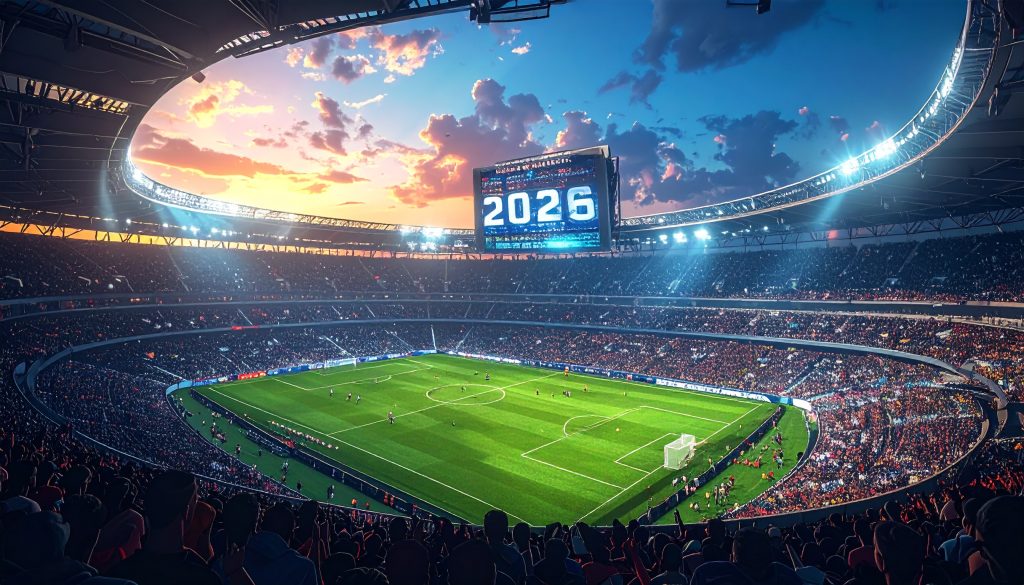

The 2026 FIFA World Cup will be the most significant inflection point in the history of modern soccer. For the first time, the tournament is expanding from 32 to 48 nations, a monumental format change that fundamentally transforms the scale of the competition. With more teams comes a record shattering 104 matches, a 63% increase over the 64 games played at Qatar 2022.
This “48-team revolution” isn’t just about more football; it’s about a complete rewriting of the record books. Co-hosted by the United States, Mexico, and Canada, the 2026 edition will be the first-ever tri-nation World Cup, stretching across 16 host cities in three different time zones. From unprecedented attendance projections of over 5 million fans to a new knockout structure that forces finalists to play eight matches instead of seven, the sheer scale of 2026 is guaranteed to shatter decades-old milestones.
From historic goal-scoring totals to massive geographic footprints, here are the ten key records that will be rewritten the moment the 2026 World Cup kicks off.
10. Most Nations Ever to Compete in a Single Tournament
The most immediate record to fall in 2026 is the sheer number of participating nations. Since 1998, the FIFA World Cup has maintained a steady field of 32 teams, but the 2026 edition will shatter this with an unprecedented 48-team field. This 50% increase represents the largest single expansion in the tournament’s nearly 100-year history.
- The Previous Record: 32 teams (held from 1998 to 2022).
- The New Record: 48 teams.
This expansion is a massive win for global inclusivity. By adding 16 more slots, FIFA has opened the door for emerging footballing nations that have historically struggled to break through the narrow qualification windows of their confederations. For example, Asia (AFC) and Africa (CAF) will see their direct qualification spots nearly double, ensuring that the “World” in World Cup is more literal than ever before. This record isn’t just about the quantity of players; it’s about the millions of new fans whose countries will be represented on the global stage for the very first time.
9. Highest Total Number of Matches
One of the most staggering records to be broken in 2026 is the sheer volume of football scheduled to be played. With the jump to 48 teams, the 2026 World Cup will feature a record-shattering 104 matches. To put that in perspective, this is 40 more games than were played during the 2022 World Cup in Qatar.
- The Previous Record: 64 matches (held since 1998).
- The New Record: 104 matches.
This dramatic increase is driven by the tournament’s revamped structure, which includes an entirely new Round of 32 knockout stage. While the group stage alone will now consist of 72 matches, the addition of a new elimination round ensures that the knockout phase is larger and more grueling than ever. This means fans will enjoy more than five weeks of continuous action, and the eventual champions will have to navigate eight matches to lift the trophy, rather than the traditional seven. This marathon format will test team depth like no other tournament in history.
8. Highest Total Number of Goals Scored
With more teams and a staggering increase in the number of games, the 2026 World Cup is statistically certain to become the highest-scoring tournament in history. The current record for total goals in a single edition was set just recently at Qatar 2022, where fans witnessed a record-breaking 172 goals.
- The Current Record: 172 goals (Qatar 2022).
- The Predicted Record: 250+ goals (estimated based on the 104-match format).
The move from 64 matches to 104 matches adds 40 additional opportunities for goals to be scored. Even if the average goals per game remains consistent with previous tournaments (typically around 2.5 to 2.7), the sheer volume of play will likely push the total well past the 250-goal mark. This “48-team revolution” provides more group-stage fixtures than there were total matches in any prior World Cup, almost guaranteeing that the 172-goal milestone will be a distant memory by the time the final whistle blows in New Jersey.
7. Largest Geographic Footprint in Tournament History
The 2026 World Cup will officially become the most geographically expansive sporting event ever staged, stretching across an entire continent. For the first time, three nations, the United States, Mexico, and Canada will jointly host the tournament across 16 different cities.
- The Previous Record: Co-hosted by two nations (South Korea and Japan in 2002).
- The New Record: Co-hosted by three nations (USA, Mexico, Canada).
This massive footprint introduces logistical challenges never seen before in football. The distance between host cities is staggering; for example, fans and teams might have to travel nearly 3,000 miles (approx. 5,000 km) between coastal cities like Vancouver and Miami. To put this in perspective, the 2026 footprint would “swallow most European nations whole”. To manage this, FIFA has divided the 16 host cities into three regional clusters, Western, Central, and Eastern to minimize travel during the early group stages. Even with these measures, the sheer scale of the North American sprawl makes this the largest “stadium-to-stadium” distance record in World Cup history.
6. Most Stadiums Used in a Single World Cup
The physical scale of the 2026 World Cup is unprecedented, and that is best reflected in the number of venues selected to host the 104 matches. For the first time, FIFA will utilize 16 world-class stadiums spread across three nations.
- The Previous Record: 12 stadiums (held by several editions including Brazil 2014 and Russia 2018).
- The New Record: 16 stadiums.
The selection includes iconic cathedrals of the sport like the Estadio Azteca in Mexico City—which will become the first stadium to host matches in three separate World Cups, alongside massive NFL venues in the United States like AT&T Stadium (Dallas) and MetLife Stadium (New York/New Jersey).
This record is a direct necessity of the 48-team expansion. With the tournament growing by 40 matches, a traditional 8- or 12-stadium setup would have put impossible strain on the pitches and local infrastructure. By utilizing 16 venues, FIFA can spread the load across the continent, ensuring that every host city remains a vibrant hub for fans while providing top-tier facilities for the athletes.
5. Largest Total Attendance in World Cup History
The 2026 World Cup is projected to shatter the all-time attendance record for a single tournament, fueled by the move to massive North American stadiums and the record 104-match schedule. FIFA is currently projecting that over 5.5 million to 6.5 million fans will attend matches in person.
- The Current Record: 3.59 million fans (USA 1994).
- The Predicted Record: 6 million+ fans.
While the 1994 World Cup (also held in the U.S.) still holds the record for the highest average attendance, averaging nearly 69,000 fans per game—the 2026 edition will easily surpass it in total numbers. The surge is driven by two factors: the sheer volume of 40 additional games and the use of NFL-sized venues like AT&T Stadium and MetLife Stadium, which boast capacities of over 80,000. This massive influx of spectators is expected to generate record-breaking gate revenues, with ticket demand already reaching historic levels—FIFA reported over 5 million ticket requests in the first 24 hours of the random selection draw alone.
4. Most Diverse Group Stage in World Cup History
The 2026 edition will feature the most diverse array of national teams ever assembled, thanks to a radical shift in how qualification slots are distributed. With the expansion to 48 teams, FIFA has moved away from a Euro-centric model to give significantly more representation to Africa, Asia, and North America.
- The Record: First tournament with 48 nations and a guaranteed record number of debutants in the modern era.
- The Global Shift: Direct slots for Africa (CAF) have nearly doubled from 5 to 9, and Asia (AFC) has jumped from 4.5 to 8 direct spots.
As of December 2025, the group stage is already set to showcase a historic variety of footballing cultures. For example, nations like Uzbekistan, Jordan, and Cape Verde have officially qualified for their first-ever World Cup, while Curaçao will become the smallest nation by population to ever compete. This diversity will be mirrored in the groups; because of the 12-group format, fans are more likely to see unique matchups—such as Germany vs. Curaçao or Argentina vs. Jordan—that would have been nearly impossible under the old 32-team system. This isn’t just about more games; it’s a fundamental change in the global representation of the sport.
3. Longest Duration for a Modern World Cup
Fans of the “beautiful game” are in for a marathon, as the 2026 World Cup is set to become the longest tournament in modern history. To accommodate the massive increase to 104 matches, FIFA has officially extended the tournament window to 39 days.
- The Previous Record: ~32 days (standard for 32-team tournaments like 2014 and 2018).
- The New Record: 39 days (June 11 – July 19, 2026).
This week-long extension is a direct result of the expanded knockout bracket. While previous editions moved quickly from the group stage to a Round of 16, the 2026 format introduces a Round of 32, adding an entire layer of high-stakes elimination games.
This change transforms the tournament from a one-month sprint into a nearly six-week endurance test. For the teams, this means longer recovery periods between matches, but for the host cities, it means a significantly longer period of economic activity, tourism, and global media attention.
2. Highest Number of Debutant Nations in the Modern Era
One of the most exciting results of the 48-team expansion is the guaranteed arrival of fresh faces on the world stage. As of late 2025, several nations have already made history by securing their first-ever qualification spots, ensuring that 2026 will feature a record-breaking surge of newcomers.
- The Previous Modern Record: 8 debutants (2006).
- The 2026 Status: At least 4 nations have already booked their first-ever trip, with the final number potentially reaching 9 or more after the inter-confederation playoffs are settled.
The confirmed debutants for 2026 represent a massive shift in the global football landscape. Uzbekistan and Jordan have emerged as new powers in Asia, while Cape Verde and Curaçao have defied the odds to represent the smaller island nations. Notably, Curaçao’s qualification makes them the smallest nation by landmass to ever reach the tournament.
This record is a direct result of FIFA’s decision to nearly double the slots available for Africa and Asia. While the 1934 World Cup technically featured 10 debutants, that was only the second tournament ever held; in the modern, competitive era of the sport, 2026 is set to provide the most significant “injection of new blood” the World Cup has ever seen.
1. Most Watched Sporting Event in Human History
The ultimate record that the 2026 World Cup is set to shatter is the one for global viewership. While the 2022 World Cup in Qatar was a massive success, reaching an estimated 5 billion people, FIFA is projecting that the 2026 edition will reach an unprecedented 6 billion viewers.
- The Current Record: 5 billion viewers (Qatar 2022).
- The Projected Record: 6 billion viewers.
To put this in perspective, FIFA President Gianni Infantino has described the expanded 104-match schedule as having “104 Super Bowls in one month”. While a Super Bowl typically draws around 120–130 million viewers, the 2026 World Cup is expected to engage nearly three-quarters of the global population.
Several factors make this record-breaking audience inevitable. First, the move to North American time zones is a “dream scenario” for broadcasters, as it allows for prime-time viewing across the massive markets of the Americas while remaining accessible to European and African audiences. Second, the 48-team expansion brings in fans from 16 additional nations, many of whom have never seen their team on this stage before. This combination of a massive geographic reach and more high-stakes matches ensures that the 2026 World Cup won’t just be a tournament—it will be the most-watched cultural event in the history of the world.
Conclusion: The Dawn of a New Era
The 2026 FIFA World Cup is more than just an expansion; it is a fundamental reimagining of the world’s most popular sport. By breaking these ten records, the “48-team revolution” will shift the center of the footballing universe toward North America, creating a legacy that will last for generations.
From the unprecedented US$727 million prize pool to the massive infrastructure investments across 16 host cities, the scale of this tournament is designed to prove that football can be truly global. While traditionalists may worry about the “dilution” of quality, the inclusion of historic debutants like Uzbekistan and Jordan ensures that the 2026 edition will be the most diverse and inclusive cultural festival in human history.
As we count down to the opening whistle at the legendary Estadio Azteca, one thing is clear: the record books aren’t just being updated, they are being rewritten entirely. Whether you are a die-hard supporter or a casual fan, the 2026 World Cup promises a spectacle of speed, skill, and scale that the world has never seen before.
Frequently Asked Questions
How many teams will play in the 2026 World Cup? For the first time in history, the field is expanding from 32 nations to 48 teams, allowing for more global representation from Africa, Asia, and North America.
How many matches will be played in 2026? The tournament will feature a record-shattering 104 matches, a significant increase from the 64 games played in previous editions.
Which countries are hosting the 2026 World Cup? It will be the first-ever tri-nation World Cup, co-hosted by the United States, Mexico, and Canada across 16 different cities.
Will the 2026 World Cup break the attendance record? Yes. With more matches and massive NFL-sized venues, total attendance is projected to exceed 6 million fans, easily surpassing the previous record of 3.59 million.
How long will the 2026 World Cup last? To accommodate the expanded format, the tournament will be the longest in modern history, spanning 39 days from June 11 to July 19, 2026.