
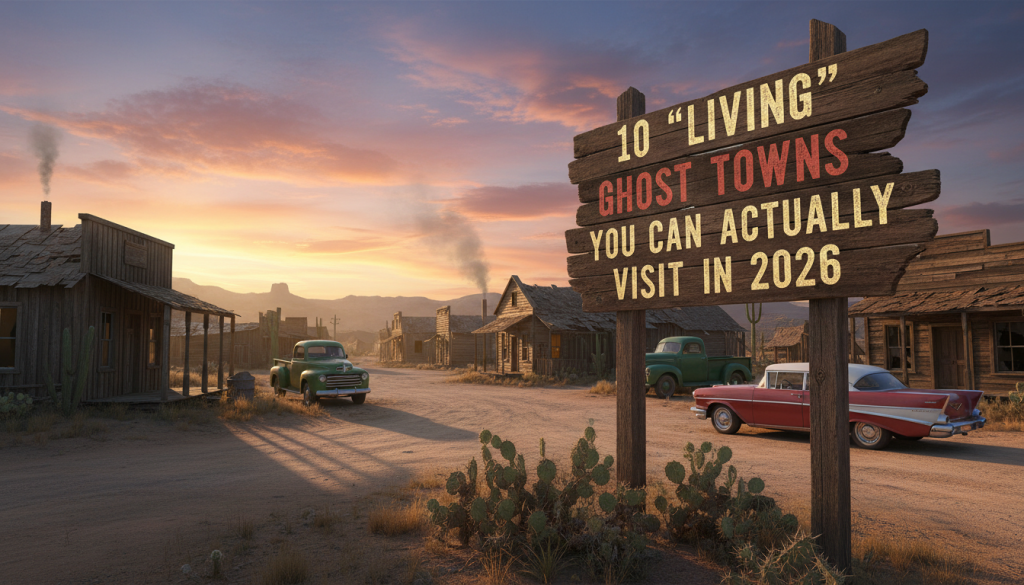

Ghost towns are often imagined as frozen in time, sealed off by decay or danger. In reality, many of the world’s most fascinating abandoned towns are still very much alive in subtle ways. Some have a handful of residents who never left. Others are carefully preserved open air museums. A few even host cafés, tours, or seasonal festivals, despite looking like the set of a post apocalyptic film.
These “living” ghost towns sit in the space between past and present. Their buildings still stand. Their streets can still be walked. Their stories are not locked behind warning signs. Visiting them is less about thrill seeking and more about stepping into history without glass cases or velvet ropes.
All of the places on this list can realistically be visited in 2026, either independently or via guided access. Some require planning and respect. Others are surprisingly easy to reach. What they share is atmosphere, silence, and the feeling that time took a wrong turn and never quite came back.
10. Bodie, California, USA
History and Abandonment:
Bodie began as a minor mining camp in 1859 but exploded after a major gold discovery in 1876. Within a few years, it had banks, saloons, newspapers, and a reputation for lawlessness. Fires, declining ore quality, and the Great Depression slowly emptied the town. By World War II, Bodie was fully abandoned.
Town Size and Layout:
At its peak, Bodie covered roughly one square mile. Today, about 110 structures remain, including wooden homes, brick commercial buildings, a church, and a schoolhouse.
Current State:
Preserved in arrested decay. Interiors still contain furniture, goods, and personal items.
Who Maintains It:
California State Parks.
Entrance Fee:
Yes.
How to Get There:
Accessible by car via a rough dirt road. Four wheel drive recommended in winter.
Time Needed to Visit:
2 to 4 hours.
Unverified Stories:
Visitors claim removing artifacts causes bad luck. Hundreds of stolen items have been mailed back over the years. No proof exists, but the legend endures.
9. Hashima Island, Japan
History and Abandonment:
Hashima Island, officially known as Gunkanjima, meaning Battleship Island, was developed in the late nineteenth century after undersea coal deposits were discovered off the coast of Nagasaki. Mitsubishi purchased the island in 1890 and transformed it into a tightly packed industrial settlement. At its peak in the 1950s, Hashima housed more than five thousand residents on just sixteen acres, making it the most densely populated place on Earth at the time. Entire families lived in reinforced concrete apartment blocks, some of the earliest high rise residential buildings in Japan.
The town existed solely for coal mining. When petroleum replaced coal as Japan’s primary energy source, the mines became unprofitable. In 1974, Mitsubishi shut operations down, and residents were evacuated in a matter of weeks. Hashima was left completely empty almost overnight.
Town Size and Layout:
Approximately sixteen acres. The town consists almost entirely of multi story concrete apartment buildings, industrial facilities, a school, a hospital, and seawalls encircling the island.
Current State:
Severely weathered but partially stabilized. Many buildings are crumbling due to salt exposure and typhoons.
Who Maintains It:
The Japanese government, with access managed by licensed tour operators.
Entrance Fee:
Yes. Entry is only possible through guided boat tours.
How to Get There:
Boat tours depart from Nagasaki Harbor and are weather dependent.
Time Needed to Visit:
1.5 to 2 hours.
Unverified Stories:
Some visitors report hearing voices or mechanical sounds despite the island being empty. These claims are unproven and are generally attributed to wind, waves, and sound echoing through concrete corridors.
8. Kolmanskop, Namibia
History and Abandonment:
Kolmanskop was founded in 1908 after diamonds were discovered in the Namib Desert during German colonial rule. The town quickly became one of the wealthiest settlements in southern Africa, featuring electric lighting, a hospital, a ballroom, a casino, and even an ice factory. European style homes were shipped in and assembled in the desert, creating an unlikely luxury enclave surrounded by sand.
As diamond deposits dwindled and richer fields were discovered closer to the coast, Kolmanskop’s importance faded. By the early 1930s, residents began leaving, and by the 1950s the town was completely abandoned. The desert reclaimed it rapidly, filling homes with sand and erasing streets.
Town Size and Layout:
Compact but well organized. One and two story wooden and plaster buildings with pitched roofs arranged along wide streets.
Current State:
Structurally intact exteriors with interiors heavily filled by sand dunes.
Who Maintains It:
Local heritage authorities manage access and preservation.
Entrance Fee:
Yes. Entry permits required.
How to Get There:
By car from Lüderitz. Guided access is mandatory.
Time Needed to Visit:
2 to 3 hours.
Unverified Stories:
Stories claim rooms refill with sand overnight. While exaggerated, rapid desert wind movement can dramatically change interiors in short periods.
7. Pripyat, Ukraine
History and Abandonment:
Pripyat was founded in 1970 as a model Soviet city to house workers at the nearby Chernobyl Nuclear Power Plant. Designed to showcase modern living, it featured schools, apartment blocks, sports facilities, and a famous amusement park scheduled to open days after the disaster.
On April 26, 1986, a reactor explosion released massive radiation. The city was evacuated within thirty six hours. Residents were told they would return shortly. They never did. Pripyat was sealed off and left to decay, becoming one of the most iconic abandoned cities in the world.
Town Size and Layout:
Roughly five square miles. Dominated by concrete apartment blocks, civic buildings, schools, and industrial infrastructure.
Current State:
Structurally standing but heavily overgrown. Nature is reclaiming buildings and streets.
Who Maintains It:
Ukrainian authorities manage safety and access through the Chernobyl Exclusion Zone.
Entrance Fee:
Yes. Guided tour fees apply.
How to Get There:
Access only via licensed tours from Kyiv, subject to safety and geopolitical conditions.
Time Needed to Visit:
Full day.
Unverified Stories:
Claims of mutant animals and paranormal sightings persist online. While wildlife populations have rebounded, no verified evidence supports abnormal mutations or supernatural activity.
6. Centralia, Pennsylvania, USA
History and Abandonment:
Centralia was founded in the mid nineteenth century as a coal mining town in eastern Pennsylvania. For decades, it functioned like many Appalachian mining communities, with schools, churches, and tightly knit neighborhoods built around the coal industry. In 1962, a fire was accidentally ignited in an abandoned coal mine beneath the town, likely during a landfill cleanup. Instead of burning out, the fire spread through interconnected mine tunnels.
Over the following decades, toxic gases, sinkholes, and ground instability made the town increasingly dangerous. The federal government relocated most residents through buyouts beginning in the 1980s. By the early 2000s, nearly all buildings had been demolished. The underground fire is expected to burn for decades, if not centuries.
Town Size and Layout:
Originally covered several square miles. Today, only fragments of the road grid remain, with empty lots where homes once stood.
Current State:
Largely erased. Smoke vents, cracked roads, and scattered foundations mark the former town.
Who Maintains It:
No formal maintenance. The site is monitored by the state for safety risks.
Entrance Fee:
No.
How to Get There:
Accessible by car. There are no visitor facilities or signage.
Time Needed to Visit:
30 minutes to 1 hour.
Unverified Stories:
Visitors report strange fog, warm ground, and humming sounds. These are not paranormal and are caused by underground combustion and escaping gases
5. Craco, Italy
History and Abandonment:
Craco dates back over a thousand years, with roots in medieval Italy. Perched atop a steep hill, it thrived as an agricultural and strategic settlement. In the twentieth century, a series of landslides, worsened by poor water infrastructure and earthquakes, slowly rendered the town unsafe. Residents were relocated in stages, with the final abandonment occurring in the 1960s.
Unlike sudden evacuations, Craco’s decline was gradual. Families moved out one by one, leaving behind homes, churches, and public buildings. The town later gained fame as a filming location, further preserving its image as a frozen medieval village.
Town Size and Layout:
Compact hilltop settlement. Stone houses, narrow alleys, stairways, and several churches dominate the landscape.
Current State:
Structurally fragile but visually intact. Entry without a guide is prohibited.
Who Maintains It:
Italian heritage authorities manage preservation and access.
Entrance Fee:
Yes. Guided tour tickets required.
How to Get There:
By car from nearby towns. Access is only permitted with an official guide.
Time Needed to Visit:
1.5 to 2 hours.
Unverified Stories:
Locals tell stories of voices carried by the wind through empty streets. These are unproven and likely acoustic effects.
4. Kayaköy, Turkey
History and Abandonment:
Kayaköy was once a thriving Greek village known as Levissi. Its abandonment was not caused by natural disaster or economic collapse, but by forced population exchanges between Greece and Turkey following World War I. In the early 1920s, the Greek Orthodox residents were expelled, and replacement populations never fully resettled the area.
Hundreds of homes were left behind almost intact. Over time, roofs collapsed and interiors decayed, but the town’s layout remains clearly visible. Kayaköy stands as a physical reminder of how political decisions can erase entire communities.
Town Size and Layout:
Sprawling hillside village with hundreds of stone houses, churches, and cobbled paths.
Current State:
Stable ruins open to public exploration.
Who Maintains It:
Turkish Ministry of Culture oversees preservation.
Entrance Fee:
Yes. Modest entry fee.
How to Get There:
By car or taxi from Fethiye. Public transport is limited.
Time Needed to Visit:
2 to 3 hours.
Unverified Stories:
Some locals describe the village as cursed or haunted. Historians attribute these stories to collective memory and displacement trauma rather than any verified phenomenon.
3. Rhyolite, Nevada, USA
History and Abandonment:
Rhyolite was founded in 1904 during a gold rush near what is now Death Valley National Park. Like many boomtowns, it grew at a staggering pace. Within a few years, it had a stock exchange, opera house, schools, hotels, and thousands of residents who believed the town would become a permanent city in the desert.
That optimism collapsed just as quickly. The surrounding mines failed to produce the gold investors expected, the financial panic of 1907 dried up funding, and rail connections were cut. By 1911, most residents had left. Within another decade, Rhyolite was effectively abandoned, stripped for building materials and left to the desert.
Town Size and Layout:
Small but dense. The remaining ruins include stone and concrete commercial buildings, a train depot foundation, and scattered residential remains.
Current State:
Open air ruins exposed to desert conditions. Several structures still stand, including the iconic bottle house foundation.
Who Maintains It:
Managed by the Bureau of Land Management.
Entrance Fee:
No.
How to Get There:
Accessible by car from Beatty, Nevada. Paved roads lead directly to the site.
Time Needed to Visit:
45 minutes to 1 hour.
Unverified Stories:
Visitors sometimes claim to see shadow figures or hear voices at dusk. There is no evidence supporting paranormal activity, and such experiences are commonly attributed to heat, light distortion, and isolation.
2. Oradour sur Glane, France
History and Abandonment:
Oradour sur Glane was a quiet rural village until June 10, 1944, when it was destroyed during a massacre carried out by German forces during World War II. Nearly the entire population was killed, and the village was burned.
After the war, the French government made a rare decision to preserve the ruins exactly as they were left. A new town was built nearby, while the original village was sealed as a memorial. Oradour was not abandoned through decline, but deliberately frozen as evidence of wartime atrocity.
Town Size and Layout:
Medium sized village. Stone and brick homes, shops, a church, and narrow streets remain intact as ruins.
Current State:
Preserved ruins, untouched and stabilized for safety.
Who Maintains It:
French government memorial authority.
Entrance Fee:
Yes. Entry to the memorial center requires a ticket.
How to Get There:
Accessible by car from Limoges. Public transport options are limited.
Time Needed to Visit:
2 to 3 hours.
Unverified Stories:
Some visitors describe an overwhelming sense of unease or silence. These reactions are widely attributed to the emotional weight of the site rather than any supernatural cause.
1. Pyramiden, Svalbard, Norway
History and Abandonment:
Pyramiden was established in the early twentieth century as a Soviet coal mining settlement in the Arctic. Designed to showcase Soviet ideals, it featured apartment blocks, a cultural center, schools, and sports facilities. At its peak, over one thousand residents lived there under strict but structured conditions.
When coal mining became economically unviable in the 1990s, the town was abruptly abandoned. In 1998, residents left behind furniture, books, and personal items. The Arctic climate preserved much of the town, slowing decay in an almost unnatural way.
Town Size and Layout:
Compact settlement at the base of a mountain. Concrete apartment blocks, a sports hall, cultural center, and administrative buildings dominate the site.
Current State:
Remarkably preserved. Some buildings are accessible, and a small hotel and museum operate seasonally.
Who Maintains It:
Private operators with caretakers on site year round.
Entrance Fee:
Yes. Guided tour access required.
How to Get There:
Reachable by boat or snowmobile from Longyearbyen, depending on season.
Time Needed to Visit:
Half day.
Unverified Stories:
Visitors sometimes report hearing music or voices in empty buildings. These claims are unproven and are generally attributed to wind, shifting structures, or heightened sensory awareness in isolation.