
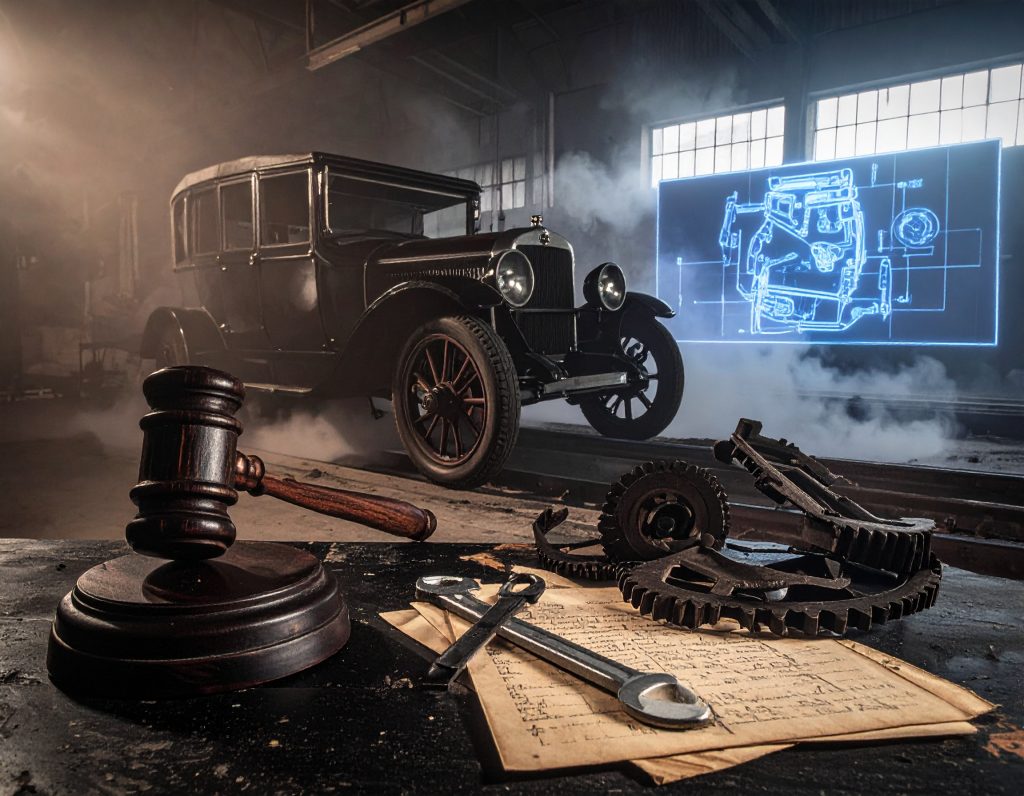

The early automobile industry wasn’t a polite race of gentlemen inventors quietly tinkering in their garages. It was an absolute battlefield.
At the turn of the 20th century, the car was a radical new technology, and whoever controlled it was guaranteed to control the future of global transportation. That meant fortunes were minted overnight and protected fiercely. Patents were weaponized. Competitors were sued into oblivion. Engineers stole designs, sabotaged their rivals, and launched overnight empires.
Behind the legendary car brands we drive today are hidden stories of courtroom brawls, corporate backstabbing, and flashes of mechanical brilliance. Here is how ten of the original automobile empires were built through a mix of ruthless competition, legal warfare, and sheer genius.
10. The Selden Patent “Tax”
In 1879, a shrewd lawyer and inventor named George B. Selden filed a patent for a “road engine.” But he didn’t build it. Instead, he intentionally delayed finalizing the patent for years, strategically amending the paperwork until automobiles actually became commercially viable.
When cars finally hit the streets in the 1890s, Selden pounced. He enforced his patent, forcing manufacturers across America to pay steep licensing fees to his Association of Licensed Automobile Manufacturers (ALAM). While many companies reluctantly complied, treating it as an unavoidable industry tax, others were furious. It was the original “patent troll” operation—until one man refused to play along.
9. Henry Ford vs. The Patent Cartel
When Henry Ford launched the Ford Motor Company, he flat out refused to pay Selden’s licensing fees. In response, the patent cartel sued him.
The resulting legal battle dragged on for years, threatening to bankrupt Ford before he could ever scale his production lines. However, in 1911, Ford won a massive victory on appeal. The court ruled that Selden’s patent only applied to a highly specific, outdated engine design and not to Ford’s modern vehicles. This landmark decision broke the ALAM monopoly, allowing Ford to mass produce cars without paying a gatekeeper. From that moment on, the American auto industry exploded.
8. Benz and Daimler: The Accidental Rivals
The first true gasoline-powered cars were built in Germany by two separate pioneers: Karl Benz and Gottlieb Daimler. The fascinating part? They were developing their revolutionary vehicles at the exact same time, in the exact same country, and yet they had never actually met.
In 1886, Benz introduced the Patent Motorwagen, widely considered the first practical automobile. Meanwhile, Daimler was focused on building compact, high-speed engines capable of powering multiple types of vehicles. Instead of collaborating, they became fierce competitors. It took decades of rivalry before the two companies finally agreed to an uneasy merger, eventually forming the legendary powerhouse we now know as Mercedes-Benz.
7. General Motors and the Wall Street War
The early history of General Motors looked less like a traditional corporation and more like a chaotic Wall Street war. Founded by William C. Durant in 1908, GM grew aggressively by buying up competing car companies at a breakneck pace.
Durant was an undeniable visionary, but he was reckless with capital. He lost control of GM to his bankers, miraculously regained it years later, and then lost it again after a series of high-stakes financial gambles. Behind the scenes, bankers and board members constantly fought for the steering wheel of the rapidly growing empire. Out of this financial chaos, however, emerged a structured corporate blueprint that went on to define the modern multinational company.
6. Ford vs. Chevrolet: A Very Personal Feud
When Louis Chevrolet co founded his namesake company, it was not just a business venture. It was a direct challenge to Henry Ford.
While Ford had perfected mass production and affordability with the utilitarian Model T, Chevrolet took a different route. He targeted drivers who wanted more power, better styling, and a touch of luxury. This sparked a decades long arms race between Ford Motor Company and General Motors, pushing both companies to innovate faster, build larger engines, and cut costs. Modern American car culture and the classic muscle car rivalry were born directly from this bitter competition.
5. Walter Chrysler’s Corporate Turnaround
Walter Chrysler didn’t start out building cars; he was a railroad mechanic. But his genius for efficiency led him to be hired to rescue the failing Maxwell Motor Company in the early 1920s.
Chrysler didn’t just save the company; he gutted it. He reorganized the entire corporate structure, completely overhauled their engineering philosophy, and relaunched the brand as the Chrysler Corporation in 1925. Within just a few short years, Chrysler rocketed to become one of the “Big Three” American automakers. To this day, it remains one of the most dramatic and successful corporate turnarounds in industrial history.
4. The Dodge Brothers vs. Henry Ford
Before they built their own cars, John and Horace Dodge were the mechanical geniuses behind Henry Ford’s success. In the early days, the Dodge brothers’ massive machine shop manufactured nearly every essential part of the Ford Model T, and they owned 10% of Ford Motor Company in return.
But as the Dodge brothers prepared to launch their own competing vehicle, Henry Ford panicked. To starve them of capital, Ford suddenly stopped paying special dividends to his shareholders. The Dodge brothers retaliated with a massive lawsuit in 1916. The bitter courtroom battle ended with the judge forcing Ford to pay out millions. John and Horace took their massive settlement, severed ties with Ford, and used his own money to launch the Dodge Brothers Motor Company—instantly becoming one of Ford’s most dangerous rivals.
3. August Horch and the Audi Name Sabotage
August Horch was a brilliant German engineer who founded his first successful car company, Horch & Cie, in 1899. However, after a series of bitter disputes with his own chief financial officer and board of directors, Horch was ousted from the very company he built.
Furious but determined, he immediately started a second car company right down the street. In an act of pure corporate sabotage, his former partners sued him for trademark infringement—and won. Horch was legally banned from using his own last name on his cars. During a meeting to find a new name, a business partner’s son, who was studying Latin in the corner of the room, offered a genius solution. “Horch” means “listen” in German. The Latin translation of “listen” is Audi. Horch adopted the name, and the Audi empire was born.
2. Lamborghini vs. Ferrari: The Ultimate Spite Empire
Ferruccio Lamborghini never intended to build supercars; he had already built a highly lucrative empire manufacturing agricultural tractors. With his immense wealth, he bought a Ferrari to enjoy on the weekends. But he was constantly annoyed by its fragile clutch, which was ironically the exact same clutch he used in his tractors.
Lamborghini drove to the Ferrari factory to offer a design improvement directly to Enzo Ferrari. Enzo, notoriously arrogant, insulted Lamborghini, telling him that a tractor maker had no business telling him how to build sports cars. Driven by pure spite, Lamborghini vowed to build a flawless grand tourer to destroy Ferrari’s reputation. He poached some of Ferrari’s best former engineers and launched Automobili Lamborghini in 1963.
What started as a petty revenge plot birthed one of the most iconic luxury car empires in history. This feud is so legendary that it was immortalized in the 2022 biographical film Lamborghini: The Man Behind the Legend, starring Frank Grillo as Ferruccio and Gabriel Byrne as Enzo. It stands as cinematic proof that sometimes the greatest catalyst for automotive genius is simply wanting to prove an arrogant rival wrong
1. Fiat and the Agnelli Family’s Ruthless Takeover
When Fabbrica Italiana Automobili Torino (FIAT) was founded in 1899, it was a joint venture funded by a group of aristocratic Italian investors. But one of those investors, a former cavalry officer named Giovanni Agnelli, had no intention of sharing power.
Agnelli saw that the automobile would dictate the future of the Italian economy. Through shrewd political maneuvering, aggressive stock buyouts, and sheer force of will, he systematically pushed out the original co-founders until he had absolute, dictatorial control of the company. Agnelli didn’t just build a car brand; he built a ruthless industrial monopoly. By aggressively lobbying the Italian government to heavily tax foreign competitors while buying up domestic rivals, the Agnelli family turned Fiat into an empire that essentially controlled Italy’s entire transportation sector for a century.
Conclusion
The birth of the automobile wasn’t a polite technological race; it was an all-out corporate war. The lawsuits, boardroom coups, and bitter rivalries that defined the early 1900s proved that surviving in the car business required more than just mechanical genius, it required absolute ruthlessness.
As we enter a new era of electric vehicles and autonomous driving, it’s worth remembering that the foundation of this massive industry was hammered out by a few rebellious pioneers who flat-out refused to play by the rules.