
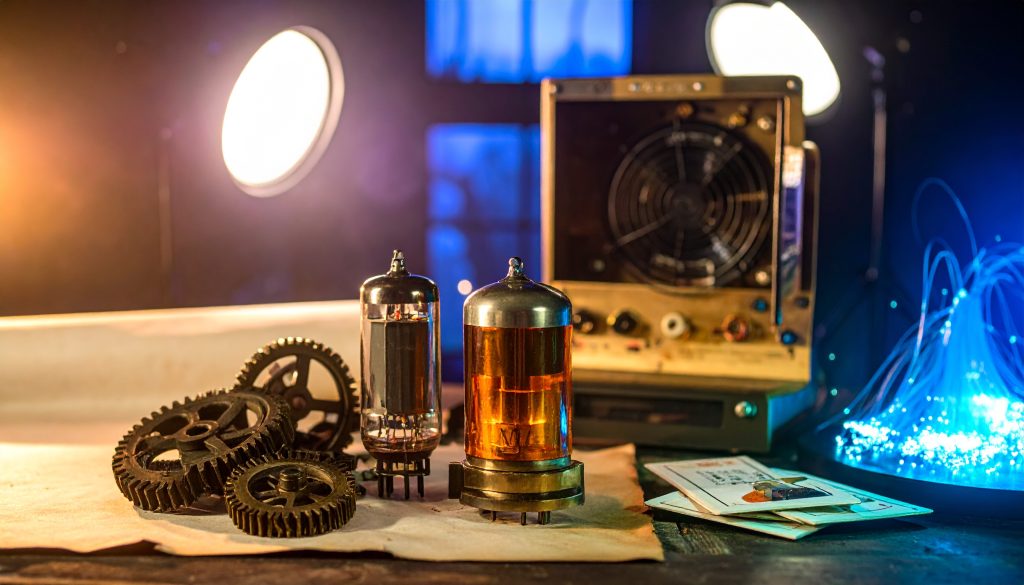

When people think of computers, they usually imagine sleek laptops, smartphones, or the massive, humming data centers that power the internet.
But the story of computing began long before microchips, electricity, or even modern mathematics.
The first “computers” were not machines in the modern sense. Some were simple sliding beads. Others were room-sized electromechanical monsters filled with miles of wire and glowing vacuum tubes. One was even built thousands of years ago using intricate bronze gears.
What they all had in common was a single, revolutionary idea: machines could perform the complex calculations that once burdened the human mind.
These early inventions didn’t just speed up math. They helped humans navigate uncharted oceans, decode enemy military messages, and lay the groundwork for the digital world we now take for granted.
Here are ten of the first computers in history, and the astonishing ways they pushed civilization forward.
10. The Antikythera Mechanism (c. 100 BCE)
In 1901, Greek sponge divers exploring an ancient shipwreck off the coast of Antikythera pulled up an encrusted lump of bronze that would rewrite the history of technology.
Often called the world’s first analog computer, this shoebox-sized device contained a staggeringly complex system of more than 30 interlocking gears.
By turning a small hand crank, ancient Greek scholars could predict astronomical events, track the four-year cycle of athletic games, and simulate the motion of celestial bodies years into the future.
It proved that ancient engineers possessed mechanical knowledge that wouldn’t be seen again for over a millennium. It demonstrated that the cosmos could be mapped and modeled using a physical machine.
9. The Abacus (c. 2400 BCE)
Before we had silicon chips, we had sliding beads. First developed in Mesopotamia, the abacus is one of the oldest calculating devices ever created.
It was later refined into the suanpan in China, alongside similar tools in Greece and Rome. This simple frame allowed users to perform addition, subtraction, multiplication, and division at speeds that rivaled mental arithmetic.
For centuries, it was the ultimate tool for merchants, engineers, and tax collectors, enabling large-scale global trade.
Its efficiency is so profound that even in the mid-20th century, expert abacus operators routinely beat early electronic calculators in speed contests.
8. Pascal’s Calculator / The Pascaline (1642)
The drive to invent often comes from a desire to avoid tedious work. French mathematician Blaise Pascal was just 19 years old when he invented the Pascaline to help his father, an overworked tax supervisor in Rouen, France.
Encased in a polished brass box, this mechanical calculator used rotating dials to perform addition and subtraction.
Crucially, it featured an automatic carry mechanism. When one dial passed nine, it automatically clicked the next dial over to one.
It was a massive conceptual leap, introducing the world to the idea that a machine could completely automate a repetitive mental task.
7. Leibniz’s Stepped Reckoner (1673)
German polymath Gottfried Wilhelm Leibniz wasn’t satisfied with Pascal’s machine, which notoriously struggled with multiplication.
He improved the concept by inventing the “stepped drum”—a cylinder with nine teeth of increasing length—to create the Stepped Reckoner. This beautiful brass machine could automatically multiply and divide.
Leibniz was a visionary who famously argued that it was beneath the dignity of excellent men to waste their hours slaving away at calculations when a machine could do it for them.
His stepped drum design was so effective it remained the core mechanism in mechanical calculators for the next two and a half centuries.
6. The Jacquard Loom (1804)
It might seem strange to include a textile machine on a list of computers, but Joseph Marie Jacquard’s loom is the grandfather of computer programming.
To automate the weaving of complex silk patterns, Jacquard invented a system of stiff pasteboard cards with holes punched in them.
Wherever there was a hole, a hook could pass through and lift a thread. Where there was no hole, the thread stayed down.
By stringing these punched cards together, a weaver could “program” the loom to create endless designs. This exact concept of binary physical code (hole/no hole) would eventually be used to feed data into the earliest electronic computers.
5. Babbage’s Analytical Engine (1837)
English mathematician Charles Babbage dreamed of a machine that could do more than just crunch numbers—he wanted a machine that could follow instructions.
The Analytical Engine is widely considered the first design for a Turing-complete, general-purpose computer. It was designed to be powered by a steam engine.
It featured a “Store” (memory) and a “Mill” (central processing unit), along with a punched-card input system borrowed directly from the Jacquard Loom.
Though Babbage never had the funding to finish building it, his collaborator, Ada Lovelace, realized the machine’s true potential. She wrote the world’s first computer algorithm for it, earning her title as the first computer programmer.
4. Babbage’s Difference Engine (1822)
Before the Analytical Engine, Babbage designed the Difference Engine, a mechanical calculator created specifically to produce error-free mathematical tables.
In the 19th century, navigators, engineers, and bankers relied on printed books of mathematical tables that were calculated by humans and riddled with life-threatening mistakes. A bad navigational table could steer a ship straight into a reef.
Babbage’s machine was designed to calculate polynomial functions and stamp the results directly into soft metal printing plates.
This entirely removed the human element—and human error—from the equation.
3. The Harvard Mark I (1944)
Fast forward to World War II, when the military desperately needed massive calculations for artillery trajectories and atomic research.
Enter the Harvard Mark I, a 51-foot-long, five-ton electromechanical beast built by IBM. Encased in glass and stainless steel, it contained over 750,000 components and sounded like a room full of knitting needles when it ran.
While it was relatively slow—taking about three seconds to multiply two numbers—it was relentless, running 24 hours a day without human intervention.
It was on a later version of this system that computing pioneer Grace Hopper found a literal moth stuck in a relay, famously coining the term “computer bug.”
2. ENIAC (1945)
The Electronic Numerical Integrator and Computer (ENIAC) was the machine that truly ushered in the electronic age.
Built at the University of Pennsylvania, ENIAC ditched slow mechanical clicking parts in favor of 18,000 glowing vacuum tubes. It could perform 5,000 additions per second—a thousand times faster than the Mark I.
Rumors claimed that when ENIAC was switched on, the lights in Philadelphia dimmed. While that is an urban legend, its impact was very real.
However, it still had a major flaw. To “program” ENIAC for a new task, a brilliant team of female engineers had to spend days physically unplugging and rerouting thousands of thick cables across the room.
1. The Manchester Baby (1948)
Officially known as the Small-Scale Experimental Machine, the Manchester Baby solved ENIAC’s biggest problem.
Built at the University of Manchester in England, it was the first computer in the world to run a “stored program.”
Instead of physically rewiring the machine to change its function, the instructions were stored purely in electronic memory using modified cathode-ray tubes.
When the Baby successfully ran its first program on June 21, 1948, the era of modern software was born. From the smartphone in your pocket to the servers powering artificial intelligence today, every modern computer still follows this exact same architecture.
Conclusion
The earliest computers were not sleek, portable, or intuitive. They were heavy, loud, and required immense specialized knowledge to operate.
Yet, each one represents a profound leap in human ambition. They pushed the boundaries of what machines could do, shifting them from tools of physical labor to partners in intellectual thought.
The digital networks that define our modern lives are not isolated, modern miracles. They are the direct descendants of ancient bronze gears, wooden looms, and the relentless curiosity of the mavericks who built them.