
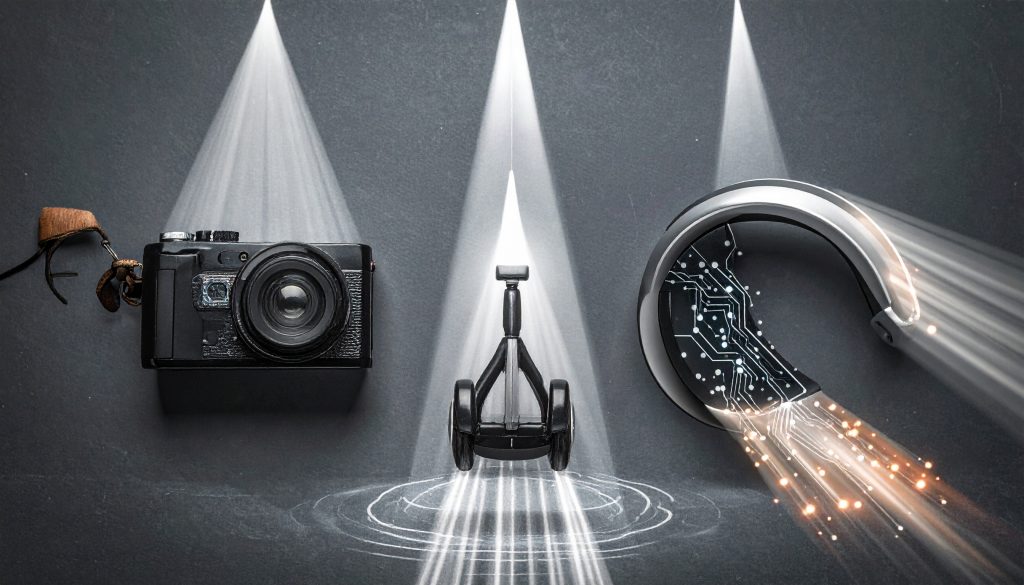

History loves winners. The iPhone. The lightbulb. The internet.
But innovation is built on failure.
Some were decades ahead of a world that wasn’t ready to receive them. Others were engineering marvels that simply couldn’t survive the brutal reality of the marketplace. Yet, if you look closely at the technology you use today, you’ll find the DNA of a “flop” that came before it.
These ten inventions didn’t just fail; they were the essential prototypes for the future. From forgotten giants to misunderstood geniuses, here is how yesterday’s biggest collapses quietly built the world we live in today.
Failure is rarely the end of innovation. Often, it’s the prototype.
10. Google Glass (2013) — The Future That Made People Uncomfortable
Google Glass was supposed to replace smartphones. Lightweight augmented reality glasses that displayed notifications directly in your field of vision. It was sleek, futuristic, and undeniably clever.
It failed almost instantly.
Privacy concerns exploded. The built in camera triggered backlash. Wearers were mocked and even banned from bars and restaurants. The device was also expensive and limited in practical use.
Why it mattered
Google Glass forced the tech industry to confront privacy in wearable computing. Today’s AR development — from Meta to Apple Vision Pro — incorporates stricter privacy signals and clearer camera indicators. Glass didn’t disappear. It evolved quietly into enterprise use, particularly in surgery and industrial training.
Sometimes society needs time to catch up.
9. The Segway (2001) — Brilliant Engineering, Wrong Assumption
When the Segway launched, insiders predicted it would reshape cities. Inventor Dean Kamen believed it would reduce car usage and revolutionize urban transport.
Technically, it was impressive. Self balancing. Gyroscopic stabilization. Elegant physics.
But cities weren’t built for it. It was too fast for sidewalks and too slow for roads. It was expensive. And it looked awkward.
Why it mattered
The Segway normalized personal electric mobility. It paved the way for e scooters and hoverboards. It also taught startups a critical lesson: infrastructure determines success as much as technology does.
Brilliance cannot override urban design.
8. Betamax (1975) — The Better Technology That Lost
Sony’s Betamax offered superior video quality compared to VHS. Many experts agreed it was the technically better format.
It still lost.
Why? Recording length. VHS tapes could record longer programs. Movie studios favored it. Rental stores adopted it. Consumer convenience beat technical superiority.
Why it mattered
Betamax proved that ecosystems matter more than specs. Content partnerships and distribution channels often determine winners. This lesson echoes today in streaming wars and gaming consoles.
The best product does not always win.
7. The Apple Newton (1993) — A Flawed Genius
The Apple Newton was one of the first personal digital assistants. It introduced handwriting recognition, digital note taking, and portable productivity.
It also became a punchline. The handwriting software was inconsistent. The device was bulky. It was expensive.
Sales flopped.
Why it mattered
The Newton laid conceptual groundwork for the iPhone and iPad. Many of its ideas — stylus input, mobile apps, portable computing — later became standard. Even Steve Jobs, who killed the Newton after returning to Apple, built on its philosophy.
Failure refined the blueprint.
6. The Concorde (1976) — Too Fast for the Economy
The Concorde was an engineering masterpiece. Supersonic passenger travel. London to New York in under three hours.
It was glamorous. It was loud. It was expensive.
Operating costs were enormous. Environmental concerns grew. A fatal crash in 2000 sealed its fate.
Why it mattered
The Concorde proved that technical possibility doesn’t equal commercial viability. It also advanced materials science, aerodynamics, and international aviation collaboration.
Today’s renewed interest in supersonic travel builds directly on Concorde’s lessons.
5. The DeLorean DMC 12 (1981) — Style Without Structure
The stainless steel sports car with gull wing doors became iconic thanks to Back to the Future. In reality, the DeLorean struggled with performance issues, manufacturing problems, and the legal troubles of its founder.
It collapsed financially within years.
Why it mattered
The DeLorean exposed how branding cannot compensate for weak operational foundations. But it also demonstrated the power of cultural redemption. The car failed commercially but became a pop culture legend.
Sometimes failure finds immortality.
4. Crystal Pepsi (1992) — A Marketing Experiment That Confused Everyone
Crystal Pepsi removed the brown color from cola, aiming to align with the “clear” health trend of the early 1990s.
Consumers were intrigued, then bewildered. The taste clashed with visual expectations. Sales plummeted.
Why it mattered
Crystal Pepsi became a case study in sensory branding. Color shapes perception. Expectation influences taste. Modern product design and packaging psychology draw heavily from this era of experimentation.
Consumers don’t just drink with their mouths. They drink with their eyes.
3. The Ford Edsel (1958) — When Market Research Goes Wrong
Ford invested heavily in market research before launching the Edsel. It was positioned as a revolutionary mid range vehicle.
The launch was disastrous.
Economic downturns, overhyped marketing, and polarizing design led to one of the most famous automotive flops in history.
Why it mattered
The Edsel reshaped how corporations approach product launches. It taught executives that data without cultural intuition can misfire. It remains a cautionary tale in MBA programs worldwide.
Even well funded genius can misread the moment.
2. The LaserDisc (1978) — Ahead of Its Time
LaserDisc delivered higher quality video and sound long before DVD existed. Cinephiles loved it.
Mainstream consumers did not.
Discs were large, players were expensive, and convenience lagged behind VHS.
Why it mattered
LaserDisc technology influenced DVD and Blu ray development. It introduced bonus features, director commentary tracks, and widescreen presentation. Today’s streaming platforms owe part of their premium feature sets to LaserDisc experimentation.
Innovation often plants seeds others harvest.
1. The Kodak Digital Camera (1975) — The Invention That Killed Its Creator
In 1975, a Kodak engineer built the first digital camera prototype. It was clunky, black and white, and recorded images to cassette tape.
Kodak executives saw the potential. They also saw the threat.
They hesitated to fully embrace digital photography because it would cannibalize their profitable film business.
Eventually, competitors seized the digital market. Kodak declared bankruptcy in 2012.
Why it mattered
Kodak’s failure is not about technology. It is about fear of disruption. It remains one of the clearest examples of how companies can invent the future and still lose it.
The lesson is brutal: innovation means little without courage.
Conclusion
These inventions did not fail because they were foolish. Many were visionary. Some were simply early. Others collided with economics, culture, or fear.
Failure is rarely wasted. It teaches markets. It trains engineers. It shapes competitors.
Invention is a relay race. One company stumbles. Another crosses the finish line.
And history remembers the winner — but it runs on the effort of the one who fell.