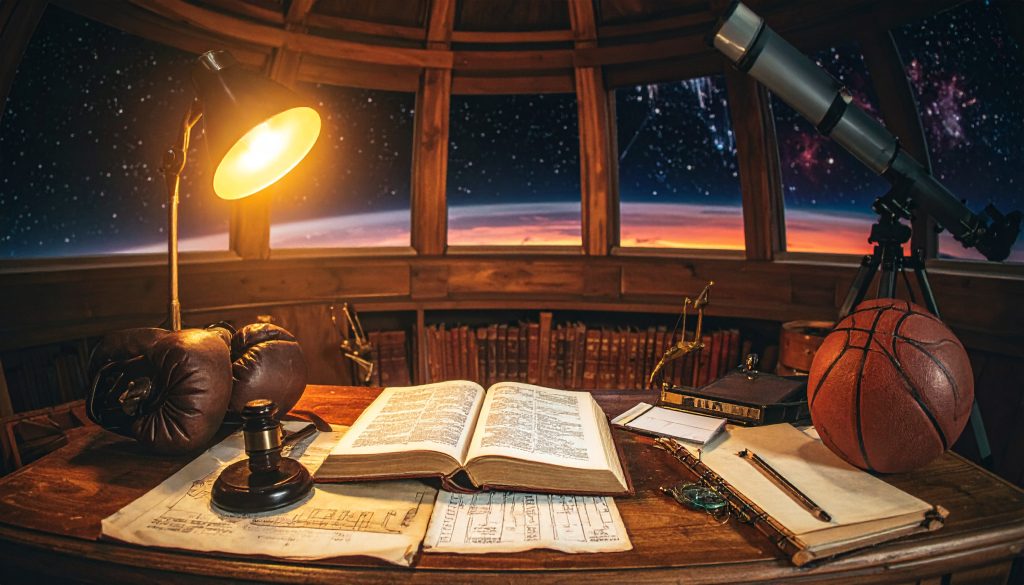

Before Edwin Hubble became the man whose name is now attached to galaxies, redshifts, and space telescopes, he lived a life that barely resembled that of a typical scientist. He grew up in Missouri and Illinois, more interested in sports and adventure than laboratory work. He boxed. He coached basketball. He tried studying law because it was the sensible thing to do. He even served in World War I before he ever pointed a telescope toward the sky.
Hubble didn’t set out to reshape our understanding of the universe—yet that’s exactly what happened. In the 1920s, when most astronomers believed the Milky Way was the entire cosmos, he revealed that it was only one galaxy among countless others. And then came the discovery that changed everything: those galaxies were moving away from us. The universe wasn’t fixed. It was growing.
But Hubble himself was far from simple. He cared deeply about image and reputation, borrowing mannerisms from British intellectuals and avoiding easy labels. His path to astronomy was winding, unlikely, and surprisingly human.
These ten facts take a closer look at the man behind one of science’s biggest breakthroughs.
10. Edwin Hubble Was a Championship Level Athlete Before He Was a Scientist
It’s strange to think that one of the world’s most important astronomers once looked more like a varsity icon than a man of science. At the University of Chicago, Hubble wasn’t dabbling in sports — he lived in them. Basketball, baseball, track… he excelled at all of it. He even broke a high‑jump record in Illinois, a detail that surprises anyone who only knows him from textbooks.
People who played with him remembered a quiet competitiveness — the kind where you don’t need to talk big because the effort speaks louder. After graduating, he coached high‑school basketball and taught Spanish, physics, and math all in the same hallway, switching roles with the same discipline he carried onto the field.
That discipline didn’t disappear when he traded the gym for Mount Wilson Observatory. Those long, cold nights weren’t easy. Staring at plates of faint stars required patience and endurance. Hubble approached science the same way he approached competition: head‑down, steady, and determined to come out on top.
His athleticism never left him; it just changed arenas.
9. He Studied Law at Oxford as a Rhodes Scholar
Winning a Rhodes Scholarship was the dream — but not entirely Hubble’s dream. He went to Oxford because his father wanted him to pursue law, and Hubble, always wanting to make him proud, followed that path. He studied jurisprudence, sat in lecture halls steeped in British tradition, and absorbed the culture so deeply that he came home with a polished accent and a refined sense of style. Some colleagues later joked that he sounded “more English than the English.”
But something didn’t sit right. After his father died, the expectations that pushed him toward law vanished, and with them, the pressure to pretend. Hubble pivoted sharply back to astronomy, completing his PhD at the University of Chicago. The legal detour wasn’t wasted, though. It taught him how to argue, how to build a case, how to defend an idea no matter who doubted him.
Those skills became invaluable when he stood before a skeptical scientific community and told them the universe was far bigger — and far stranger — than they ever imagined.
8. He Served in World War I Before Changing Astronomy
Edwin Hubble earned his PhD in 1917 — and almost immediately traded the observatory for a uniform.
He enlisted in the U.S. Army during World War I and was commissioned as a major in the 86th Division. Though the war ended before his unit saw prolonged front line combat, Hubble trained troops, prepared for deployment, and served in France during the closing phase of the conflict.
The war interrupted his scientific momentum at a pivotal moment. But it also hardened him.
Letters from this period show a tonal shift. The youthful intellectual experimenting with law, athletics, and astronomy gave way to a more controlled, deliberate figure. After the war, he carried himself with military precision. He often preferred to be addressed as “Major Hubble” even in academic circles. It wasn’t affectation. It was identity.
When he returned to the United States in 1919, he stepped directly into a position at Mount Wilson Observatory in California. There he gained access to the 100 inch Hooker Telescope — the most powerful in the world.
The timing was extraordinary.
He had discipline. He had authority. And he now had the instrument that would expand the known universe.
Within a few years, the cosmos would no longer fit inside the Milky Way.
7. He Proved the Milky Way Is Not the Entire Universe
For generations, astronomers believed the Milky Way was everything — every star, every nebula, every dream of what might exist beyond. The idea of other galaxies was unsettling, almost too vast to picture. Then Hubble turned the Hooker Telescope toward the Andromeda “Nebula” and saw something no one else had seen clearly enough to understand.
Inside that faint spiral blur, he identified Cepheid variable stars — the cosmic distance markers that changed everything. With them, he proved Andromeda wasn’t part of the Milky Way. It wasn’t even close. It was its own island of stars, unimaginably far away.
That single discovery didn’t just shift astronomy. It shattered the boundaries of the known universe. Overnight, humanity’s cosmic neighborhood went from one galaxy to millions.
The universe got bigger. We got smaller. And Hubble’s name became permanently tied to the moment the sky opened up.
6. He Discovered That the Universe Is Expanding
Imagine looking at distant galaxies and realizing they’re all moving away — not because we’re special, but because space itself is stretching under them. That’s the leap Hubble made in 1929. By studying how light from distant galaxies was reddened as they rushed away, he found a pattern: the farther a galaxy was, the faster it seemed to flee.
It was the first clear evidence that the universe wasn’t still. It wasn’t frozen in place like a painted backdrop. It was expanding — growing — alive in a way no one had expected.
Belgian physicist Georges Lemaître had suggested such a thing years earlier, but Hubble’s observations gave the idea weight. With data behind it, the concept transformed from a bold theory into the foundation of modern cosmology. His work laid the first stone of what we now call the Big Bang.
It’s hard to overstate how radical that idea was. Hubble didn’t just change a theory — he redefined reality.
5. Albert Einstein Visited Him and Changed His Mind
In 1931, Albert Einstein climbed up to Mount Wilson Observatory, curious about the man whose findings challenged his own views of the universe. Einstein had introduced a “cosmological constant” into his equations to keep the universe static — a universe without motion or change.
Then he saw Hubble’s evidence.
The visit wasn’t dramatic or theatrical, but afterward, Einstein reportedly admitted that the universe was expanding after all. His cosmological constant, he said later, might have been his “greatest blunder.”
Whether he said those exact words or not, one thing is certain: Hubble’s observations forced even the most celebrated physicist in history to adjust his worldview.
It’s not often you watch someone change Einstein’s mind.
4. He Cared Deeply About Prestige and Recognition
Behind Hubble’s calm, aristocratic exterior was a man who cared — maybe more than he liked to admit — about status, legacy, and how history would remember him. He believed astronomy deserved the same respect as physics and openly fought for astronomers to be eligible for Nobel Prizes. In his mind, the work was just as demanding and just as fundamental.
Colleagues described him as formal, sometimes fiercely so. He preferred being addressed as “Major Hubble,” a nod to his time in the Army, and his suits were always sharp enough to suggest he was ready to step into a parliament chamber.
Some found it excessive; others found it charming. But one thing is clear: Hubble understood the power of perception. He wanted astronomy not just to be studied — he wanted it to be honored.
And he played that role with conviction.
3. The Hubble Space Telescope Was Named in His Honor
When NASA launched the Hubble Space Telescope in 1990, it wasn’t just unveiling a piece of technology; it was paying tribute to the man who made modern cosmology possible. The decision carried weight. Hubble had died decades earlier, but his influence had only grown. Naming the telescope after him felt less like a gesture and more like a promise — that his work would continue to reach deeper into the universe.
And it did. Images like the Pillars of Creation and the Hubble Deep Field reshaped the way we see the cosmos. The telescope revealed colors, structures, and distant galaxies Hubble himself could only dream of glimpsing.
His name now orbits Earth, literally circling the world he once expanded with nothing more than light, glass, and determination.
2. He Almost Won a Nobel Prize
Hubble came closer to a Nobel Prize than most people realize. In fact, he was right on the edge of winning one. By the early 1950s, his discoveries about galaxies and the expanding universe were finally being recognized outside astronomy, and several prominent scientists quietly pushed for him to receive the Nobel Prize in Physics. It would have been historic—no astronomer had ever earned one before.
What makes the story bittersweet is that the rules at the time technically didn’t include astronomy as a qualifying field. Even so, the Nobel committee debated his case seriously, which shows just how groundbreaking his work had become. According to accounts from committee members, Hubble was under genuine consideration.
Then came the painful twist: the committee decided a Nobel in astronomy could be awarded after all—just not in time. Hubble died suddenly in 1953 before the decision could be finalized. And because Nobels are never given posthumously, his chance disappeared instantly.
It’s one of those moments in scientific history that still feels unfair. The man who expanded the universe for the rest of us never got to hear the committee say the words he spent a career earning.
1. He Redefined Humanity’s Place in the Universe
When Edwin Hubble pointed the Mount Wilson telescope toward the sky in the 1920s, he wasn’t just collecting data—he was quietly pulling the rug out from under everything people believed about the cosmos. At the time, most astronomers were convinced the Milky Way was the entire universe. That was the accepted story, the one everyone grew up with. But Hubble saw something different.
By studying faint, fuzzy “nebulae,” he discovered that they weren’t clouds inside our galaxy at all—they were galaxies themselves, unimaginably far away. Suddenly, the universe wasn’t a single island of stars. It was an ocean, and we were living on just one small shore.
And he didn’t stop there. He noticed that these galaxies were drifting away from us, their light stretched by motion. The universe wasn’t frozen in place as many imagined, it was expanding. Growing. Changing. Alive in a sense that no one had dared consider.
It’s hard to overstate how shocking this was. One day humanity thought it understood its cosmic address; the next day, Hubble moved the boundaries so far outward that the old worldview never recovered. In a single leap, he made the universe feel bigger, stranger, and far more awe‑inspiring.
He didn’t just shift the map. He rewrote our place on it.