
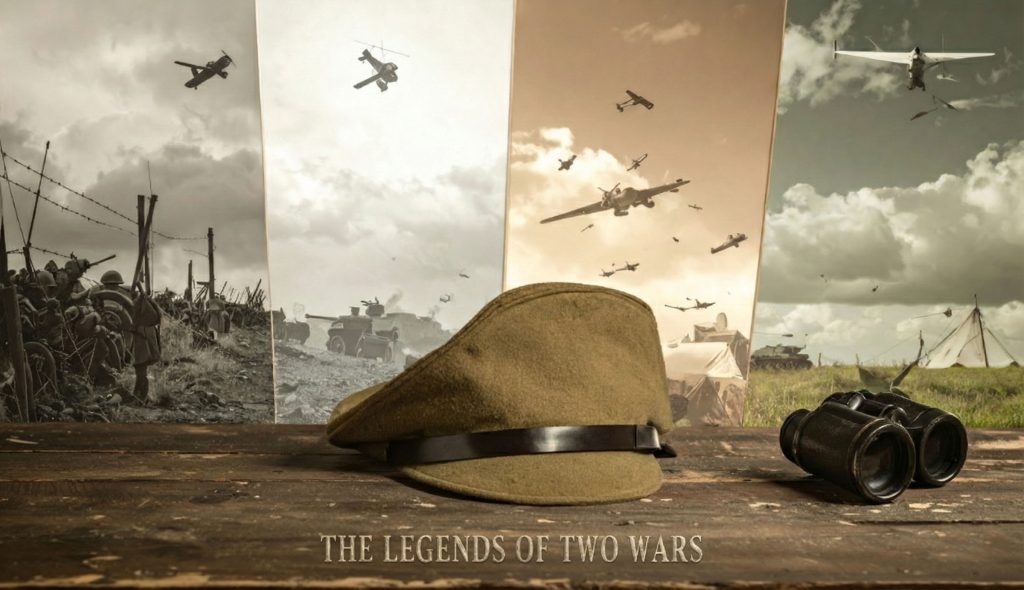

For many people across Europe, Asia, and beyond, living through one world war was already a lifetime of hardship. Yet millions of civilians endured two global conflicts marked by shortages, air raids, displacement, and loss. Entire cities were rebuilt only to be destroyed again. Families recovered, then fractured once more. While civilians struggled to survive at home, a small group of world war heroes found themselves drawn back into uniform, older and permanently changed.
These men experienced war in radically different forms. They fought in muddy trenches and cavalry charges, then returned decades later to face tanks, bombers, and mechanized armies. Between the wars, they lived full lives as teachers, reformers, politicians, critics, and sometimes reluctant leaders. Their bodies aged, their beliefs hardened or shattered, and their reputations as world war heroes grew heavier than their medals.
This list focuses on ten incredible world war heroes who fought in both World War I and World War II, examining not just their service records but their humanity. These are stories of endurance, adaptation, and the psychological cost of watching the world collapse twice.
10. Douglas MacArthur (United States)
WWI Role: Brigadier General, American Expeditionary Forces
WWII Role: Supreme Allied Commander, Pacific Theater
Born: January 26, 1880 (Little Rock, Arkansas, USA)
Died: April 5, 1964 (Washington, D.C., USA)
Early Life & Background:
Douglas MacArthur was born into a prestigious military family. His father was a Civil War hero, and his upbringing on army posts shaped his identity from childhood. He married Jean Faircloth in 1937, and they had one son. MacArthur believed deeply in destiny and legacy, often seeing himself as part of a larger historical arc.
Between the Wars:
After World War I, MacArthur became one of the youngest generals in U.S. history. As Superintendent of West Point, he introduced sweeping reforms that challenged long standing traditions. Later, as Army Chief of Staff during the Great Depression, he faced severe budget cuts while pushing modernization. His years advising the Philippine military deeply influenced his strategic thinking.
Acts of Bravery or Narrow Escape:
In World War I, MacArthur personally led trench raids under heavy fire, often refusing protective gear. In World War II, he narrowly escaped Japanese capture during the fall of the Philippines and famously vowed, “I shall return.”
The Human Connection:
MacArthur was theatrical, eloquent, and supremely confident. Admirers found him inspiring, critics saw arrogance.
How He Changed:
He evolved from a daring frontline officer into a symbolic commander whose power rested on reputation rather than proximity to combat.
9. George S. Patton (United States)
WWI Role: Tank Corps Officer
WWII Role: Commander, U.S. Third Army
Born: November 11, 1885 (San Gabriel, California, USA)
Died: December 21, 1945 (Heidelberg, Germany)
Early Life & Background:
Patton was raised on stories of ancient warriors and American military heroes. He married Beatrice Ayer in 1910 and had three children. As a child, he struggled with dyslexia, which fueled his obsession with discipline, memorization, and ritual.
Between the Wars:
Patton became an early advocate of armored warfare when tanks were still dismissed by many. His ideas often outpaced institutional acceptance, and his temper slowed promotions. Still, his influence quietly shaped U.S. doctrine.
Acts of Bravery or Narrow Escape:
Wounded while leading tanks in World War I. In World War II, his career nearly collapsed after slapping soldiers suffering from combat fatigue.
The Human Connection:
Patton believed he had lived past lives as ancient soldiers and wrote poetry about reincarnation.
How He Changed:
He grew from an experimental officer into a feared commander, though war exposed the limits of his worldview.
8. Stanisław Maczek (Poland)
WWI Role: Infantry Officer, Austro-Hungarian Army
WWII Role: Commander, 1st Armored Division (Poland)
Born: March 31, 1892 (Szczerzec, Austro-Hungary / now Ukraine)
Died: December 11, 1994 (Edinburgh, Scotland)
Early Life & Background: Before the world went to war, Maczek was a student of philosophy and psychology at Lwów University. This academic foundation shaped his approach to leadership, as he often used his understanding of human behavior to maintain the high morale of his troops during their most difficult retreats. He married Zofia Kurys in 1928, and they had three children.
Between the Wars: Maczek became a pioneer of Polish motorized warfare during the interwar years. He commanded the 10th Motorized Cavalry Brigade—famously nicknamed the “Black Brigade” because of their black leather jackets—and was the only Polish commander never to be defeated in the field during the 1939 invasion.
Acts of Bravery or Narrow Escape: During WWI, he survived the brutal mountain fighting on the Italian Front. In WWII, after escaping through Hungary and France, he eventually led the 1st Armored Division in the liberation of the Netherlands. He famously liberated the city of Breda using tactical flanking instead of artillery, saving the lives of thousands of civilians and preserving the historic city.
The Human Connection: Known affectionately as “Baca” (highlander shepherd) by his soldiers, he was a deeply protective leader. After the war, the communist government stripped him of his Polish citizenship, forcing him to work as a bartender in Edinburgh for decades. He served drinks to people who often had no idea they were being served by one of the greatest tank generals of the war.
How He Changed: He transitioned from a scholar of the mind to a master of the machine, successfully using modern armor to reclaim his continent. He lived to the age of 102, finally seeing his citizenship restored and receiving the highest honors of a free Poland after the fall of the Iron Curtain.
7. Georgy Zhukov (Soviet Union)
WWI Role: Cavalryman, Russian Imperial Army
WWII Role: Marshal of the Soviet Union
Born: December 1, 1896 (Strelkovka, Russian Empire)
Died: June 18, 1974 (Moscow, Soviet Union)
Early Life & Background:
Georgy Zhukov was born into extreme poverty in rural Russia. Before the army, he worked as a furrier’s apprentice, enduring long hours and harsh conditions that shaped his resilience. Conscripted into the Imperial Army during World War I, Zhukov entered military life with no political ambition and little formal education. He later married Alexandra Zuikova and had two daughters, though his career often kept him distant from family life.
Between the Wars:
After the Russian Revolution, Zhukov joined the Red Army and aligned himself not with ideology but with professionalism. During the interwar years, he focused on training, logistics, and large scale maneuver warfare. He rose steadily through the ranks and survived Stalin’s brutal purges largely because his competence made him indispensable. Unlike many peers, he avoided politics and concentrated entirely on military effectiveness.
Acts of Bravery or Narrow Escape:
In World War I, Zhukov fought in brutal cavalry engagements and earned decorations for bravery. In World War II, he played a decisive role in halting the German advance on Moscow in 1941, coordinating desperate counteroffensives under extreme winter conditions that nearly broke both soldiers and equipment.
The Human Connection:
Zhukov was blunt, emotionally reserved, and uninterested in flattery. He was known for speaking honestly even to Stalin, a dangerous habit that few survived.
How He Changed:
Zhukov transformed from a mounted cavalryman into the architect of Soviet mechanized warfare. Physically hardened and professionally ruthless, he emerged as the Soviet Union’s most effective commander, shaped by decades of uninterrupted conflict.
6. Sir Adrian Carton de Wiart (United Kingdom)
WWI Role: Infantry Officer, 4th Royal Irish Dragoon Guards
WWII Role: Major-General; Head of British Military Mission to China
Born: May 5, 1880 (Brussels, Belgium)
Died: June 5, 1963 (County Cork, Ireland)
Early Life & Background: Born into a titled family, Carton de Wiart was a restless spirit who began his military career by faking his age to serve in the Boer War. He married Countess Friederike Maria Karoline Henriette Rosa Sabina Franziska Fugger von Babenhausen in 1908, with whom he had two daughters. Military life was his true home; he once famously stated he felt “at his best” in the heat of combat.
Between the Wars: During the interwar years, he spent much of his time in Poland, living on a large estate in the Pripet Marshes. He became a close associate of Polish leaders and spent his days hunting and fishing, maintaining his military readiness while enjoying a life of rustic aristocracy before the storm of 1939.
Acts of Bravery or Narrow Escape: In WWI, he was shot in the face, head, stomach, and leg; he even bit off his own shattered fingers when a doctor refused to amputate them. In WWII, he survived a plane crash in the Mediterranean at age 60, swam a mile to shore, and later escaped an Italian POW camp by tunneling through a wall.
The Human Connection: Carton de Wiart was the embodiment of “unbreakable” grit, famously wearing a black eyepatch and an empty sleeve. Despite his fearsome appearance, he was known as a charming and witty conversationalist who remarkably claimed, “Frankly, I enjoyed the war.”
How He Changed: He transformed from a reckless young officer into a legendary “unkillable” icon. While his body was a map of scars from a century of conflict, his spirit remained that of a Victorian adventurer who simply refused to acknowledge defeat.
5. Charles de Gaulle (France)
WWI Role: Infantry Officer
WWII Role: Leader of the Free French Forces
Born: November 22, 1890 (Lille, France)
Died: November 9, 1970 (Colombey-les-Deux-Églises, France)
Early Life & Background:
Charles de Gaulle was born into a patriotic, intellectual family and raised on ideas of French honor and national destiny. He married Yvonne Vendroux in 1921, and they had three children. His family life remained private, but deeply important to him, especially caring for his disabled daughter.
Between the Wars:
Between the wars, de Gaulle became a military thinker, advocating armored and mobile warfare. His ideas were largely dismissed by French leadership, leaving him frustrated and professionally sidelined. Still, he continued writing and refining his vision of modern warfare.
Acts of Bravery or Narrow Escape:
In World War I, de Gaulle was wounded and captured at Verdun, spending years as a prisoner of war. In World War II, he escaped occupied France to Britain, where he defied the Vichy government and rallied resistance forces from exile.
The Human Connection:
De Gaulle was austere, proud, and deeply serious. He believed France was eternal, even when its government collapsed.
How He Changed:
Once an overlooked officer, de Gaulle emerged as the embodiment of French resistance, transforming from military theorist into national symbol and eventual statesman.
4. Lauri Törni / Larry Thorne (Finland/United States)
WWI Role: Finnish Civil Guard Veteran (Post-WWI conflicts)
WWII Role: Elite Infantry Captain (Finland/Germany)
Born: May 28, 1919 (Viipuri, Finland)
Died: October 18, 1965 (Quảng Nam Province, Vietnam)
Early Life & Background: Törni grew up in Finland during a period of intense national struggle. He joined the military at a young age, and his identity became inseparable from the defense of his homeland. Unlike many on this list, Törni’s life was defined by a singular, unrelenting opposition to communism, which drove him to fight under three different flags.
Between the Wars: Following the Winter War and Continuation War, Törni found himself a man without a country after being arrested for treason for his service with German forces. He escaped prison and eventually made his way to the United States as a “displaced person,” working as a carpenter and cleaner before the Lodge Act allowed him to join the U.S. Army.
Acts of Bravery or Narrow Escape: In WWII, he led “Detachment Törni,” an elite Finnish unit so effective the Soviets placed a bounty on his head. After joining the U.S. Green Berets, he survived numerous high-risk missions in the early years of the Vietnam War before his helicopter disappeared during a classified operation in 1965.
The Human Connection: Törni was a quiet, intense man who spoke little but led by example. He was a “soldier’s soldier” who never married, dedicating his entire existence to the art of warfare and his staunch political convictions.
How He Changed: He evolved from a national hero in Finland to a legendary Green Beret in the United States. His journey represents the ultimate “soldier of fortune,” a man who successfully adapted his elite guerrilla tactics from the frozen forests of Karelia to the humid jungles of Southeast Asia.
3. Smedley Butler (United States)
WWI Role: Senior Marine Corps Officer
WWII Role: Influential Military Critic and Public Figure
Born: July 30, 1881 (West Chester, Pennsylvania, USA)
Died: June 21, 1940 (Philadelphia, Pennsylvania, USA)
Early Life & Background:
Smedley Butler was born into a politically connected family and joined the Marine Corps at just sixteen years old. He married Ethel Peters, and they had three children. Butler’s early career took him across the globe in conflicts that predated the world wars, shaping him into one of the most experienced American officers of his generation.
Between the Wars:
After World War I, Butler became increasingly disillusioned with military intervention. During the interwar period, he emerged as a public critic of war profiteering and political corruption. His outspoken views cost him promotions but earned him respect from ordinary soldiers and civilians.
Acts of Bravery or Narrow Escape:
In World War I, Butler commanded Marines in France under intense conditions, reinforcing his reputation for courage. In the 1930s, he exposed what became known as the “Business Plot,” an alleged attempt to overthrow the U.S. government, risking his reputation and safety.
The Human Connection:
Butler famously declared, “War is a racket.” His blunt honesty contrasted sharply with the political climate of the time.
How He Changed:
He transformed from decorated war hero into one of the most vocal anti war figures in American history, physically worn and morally awakened by decades of service.
2. Philippe Leclerc de Hauteclocque (France)
WWI Role: Military Cadet
WWII Role: General, Free French Forces
Born: November 22, 1902 (Belloy Saint Léonard, France)
Died: November 28, 1947 (Colomb Béchar, Algeria)
Early Life & Background:
Leclerc was born into a noble French family and raised with a strong sense of duty. He married Thérèse de Gargan and had eight children. His faith and family life provided stability amid years of war.
Between the Wars:
Leclerc received formal military education and served in France’s colonial forces. These years refined his leadership style and hardened him to harsh conditions.
Acts of Bravery or Narrow Escape:
In World War I, Leclerc was still in training, witnessing the war’s aftermath firsthand. During World War II, he escaped German captivity and went on to lead daring campaigns across Africa and Europe, including the liberation of Paris.
The Human Connection:
Leclerc was deeply religious and known for quiet resolve rather than grand speeches.
How He Changed:
He evolved from a junior officer shaped by defeat into a symbol of France’s military rebirth, carrying the weight of national redemption.
1. Arthur “Bomber” Harris (United Kingdom)
WWI Role: Bomber Pilot, Royal Flying Corps
WWII Role: Commander in Chief, RAF Bomber Command
Born: April 13, 1892 (Cheltenham, England)
Died: April 5, 1984 (Oxfordshire, England)
Early Life & Background:
Harris grew up in England and Rhodesia, developing independence early. He married Therese Hearne, and they had three children. His experiences abroad shaped his direct and unsentimental outlook.
Between the Wars:
Between conflicts, Harris became a strong advocate for strategic bombing, convinced that air power could shorten wars. His views were controversial but influential as air forces modernized.
Acts of Bravery or Narrow Escape:
In World War I, Harris flew dangerous bombing missions in fragile aircraft. In World War II, he faced intense political pressure and public criticism for his role in area bombing campaigns, surviving not physical danger but moral and reputational storms.
The Human Connection:
Harris was stubborn and unapologetic, once stating that bombing campaigns were essential regardless of public opinion.
How He Changed:
He transitioned from hands on pilot to architect of industrial scale warfare, carrying the psychological weight of decisions that affected millions.
Conclusion: The Legacy of These World War Heroes
The ten soldiers on this list were more than just names in a history book; they were the human bridges between two vastly different eras of warfare. In World War I, many of them faced the mud and horses of the 19th-century military tradition. By World War II, they were commanding the mechanized, atomic, and jet-powered forces that would define the modern world.
Their “People & Personalities” profiles reveal a common thread: a unique blend of grit, adaptability, and often, a surprising sensitivity behind the uniform. Whether it was Patton’s secret poetry or de Gaulle’s devotion to his daughter, these personal details remind us that history is made by individuals with complex lives, families, and fears. Their stories serve as a testament to human resilience in the face of a century of total war.
Frequently Asked Questions (FAQ)
How common was it for soldiers to fight in both WWI and WWII? While millions served in each war, the “Double-War” veteran was relatively rare among the rank-and-file due to the 21-year gap between the conflicts. However, it was very common for the high-ranking officers of WWII to have begun their careers as young lieutenants or captains during WWI.
Who is the most decorated soldier to serve in both wars? Many on this list hold high honors, but Sir Adrian Carton de Wiart is often cited for his sheer number of wounds and decorations, while Smedley Butler remains one of the few to earn the Medal of Honor twice before the second global conflict began.
Did any soldiers fight on different sides in each war? Yes. Some soldiers, due to shifting national borders or political changes, found themselves in different uniforms. A famous example is Lauri Törni (Larry Thorne), who fought for Finland and Germany against the Soviets, and later joined the U.S. Army.
What was the biggest change these soldiers saw between the two wars? The most significant shift was mechanization. Veterans who began WWI with horse-drawn artillery and bolt-action rifles ended WWII managing massive tank divisions, radar technology, and the birth of jet aircraft.
Are there any “Double-War” veterans still alive today? Unfortunately, no. Given that a soldier would have had to be at least 16–18 years old in 1918, they would be over 120 years old today. The last veterans of WWI passed away in the early 2010s.