

The modern Olympic Games are a remarkably polished machine. Events have strict rules, athletes compete in standardized venues, and the International Olympic Committee spends years deciding which sports deserve a place on the world’s biggest sporting stage. But the early Olympics were a very different beast. The Games of 1900 and 1904, in particular, were chaotic testing grounds where organizers experimented with events that ranged from unconventional to downright bizarre.
Long before synchronized diving became a perfectly choreographed Olympic spectacle, athletes were dueling with wax bullets. Elsewhere, swimmers were climbing over boats in the Seine, competitors were being judged on how far they could glide underwater without moving, and one event involved shooting actual live pigeons.
Most of these forgotten Olympic sports lasted for only one Games or a handful of appearances before disappearing completely. Some were too dangerous, others too obscure, and a few were simply too ridiculous to survive the march toward a more standardized Olympic program.
Here are 10 bizarre Olympic sports that were completely erased from Olympic history.
10. Tandem Bicycle Sprint (1908–1972)
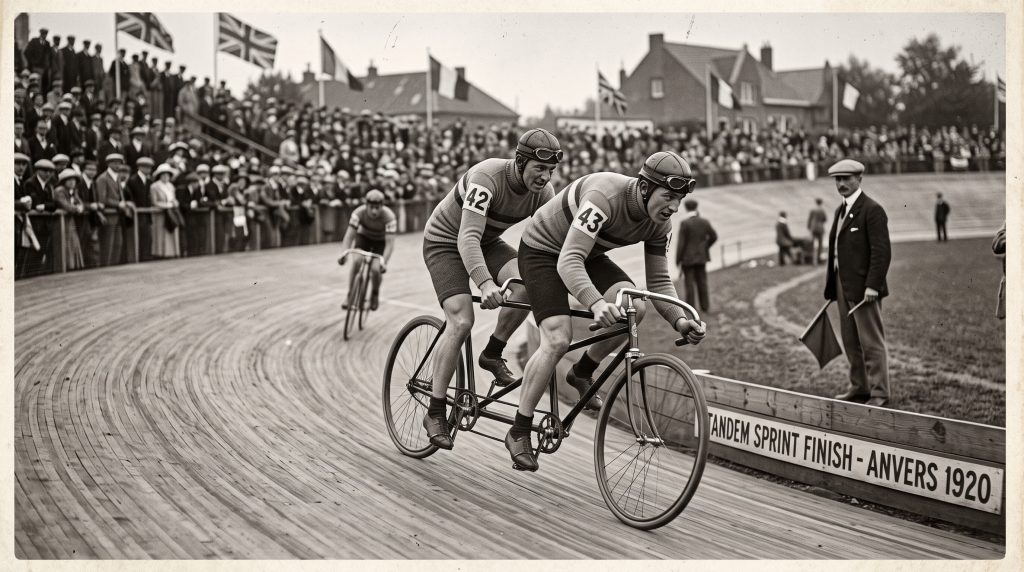
Imagine the regular Olympic cycling sprint, then add a second cyclist and bolt the two bicycles together. That was essentially the tandem sprint. Two riders shared one long tandem bike, worked a single set of handlebars and pedals at each position, and raced over 2,000 meters on the velodrome. The event demanded near perfect coordination because both riders had to accelerate, corner, draft and sprint while physically chained to the same machine. It featured at the Olympics from 1908 through 1972, apart from 1912 when no track cycling events were held.
Tandem racing looked gloriously ridiculous and was every bit as awkward as you might imagine. Two elite cyclists could be individually brilliant and still become a wobbling mechanical disaster when placed on the same bike. At the 1908 Olympics, French riders Maurice Schillès and André Auffray had never even ridden together before their first heat, yet somehow went on to win gold. The event also produced the sort of close quarters drama that made cycling officials nervous, with the 1908 silver medalists protesting that the French pair had cut them off on the final turn. The protest was rejected, but it neatly demonstrated one problem with the format: when four riders on two enormous bicycles tried to occupy the same patch of track, things could get very messy.
The tandem sprint’s Olympic career finally ended after the 1972 Munich Games, where the Soviet Union won gold in the final Olympic edition of the event. By then, the attraction had faded, and the event was eliminated because it was not popular enough. The 1976 Montreal program dropped it, leaving the Games with four men’s track cycling events instead of five. In other words, the tandem bike was not defeated by danger, controversy or some scandalous rules violation. It was simply judged too niche for the increasingly streamlined Olympic program.
9. Club Swinging (1904, 1932)
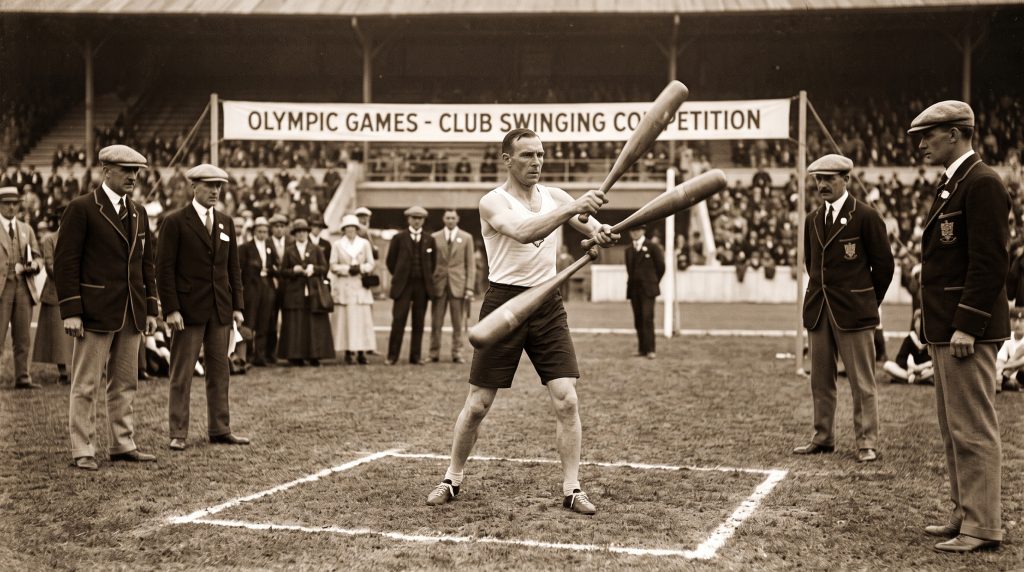
Long before juggling clubs became a circus staple, Indian club swinging was a serious physical training method and, briefly, an Olympic sport. Competitors performed choreographed routines while swinging weighted wooden clubs around their bodies in increasingly elaborate patterns. At the 1904 St. Louis Olympics, athletes had five minutes to perform with clubs weighing about three pounds, with three judges awarding up to 15 points for the routine. By 1932, the format had changed slightly, with competitors required to swing two 1.5 pound clubs for at least four minutes.
There was no tackling, sprinting or heroic photo finish here. The drama came from watching grown men aggressively choreograph what looked like an extremely elegant attempt to avoid hitting themselves with wooden bowling pins. And yet, this was hardly a joke to the competitors. Club swinging had a genuine competitive tradition in the United States, where national championships continued for decades. The Olympic problem was that almost nobody outside America seemed interested. In 1904, only three athletes competed, all from the United States. When the event returned in Los Angeles in 1932, the field had expanded to just four competitors: three Americans and one Mexican gymnast.
Club swinging disappeared from the Olympic program after its second and final appearance at the 1932 Los Angeles Games. The precise removal decision is less dramatic than the sport itself: it simply lacked international popularity. Although American championships continued until 1953, the event never became popular in other nations. With Olympic organizers increasingly favoring events that attracted broad international participation, there was little reason to keep awarding medals for something that was essentially a niche American specialty. The clubs were packed away, and Olympic history quietly moved on.
8. Solo Synchronized Swimming (1984–1992)
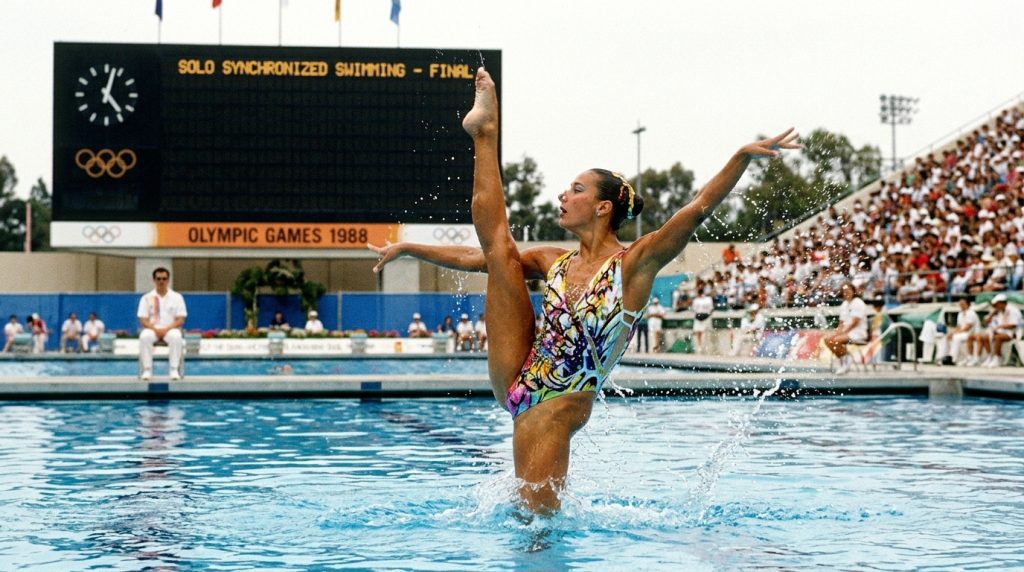
Yes, “solo synchronized swimming” sounds like a contradiction, but it was absolutely an Olympic event. A single swimmer performed a carefully choreographed routine in the pool, combining figures, underwater movements and a musical routine while judges scored technique and artistic execution. The athlete had to make every movement look effortless while holding breath, maintaining precise body positions and matching the choreography to the music. Solo synchronized swimming debuted at the Los Angeles 1984 Olympics and was contested again at Seoul 1988 and Barcelona 1992.
The strangest part was not the underwater acrobatics. It was the absurdity of trying to synchronize with absolutely nobody. The swimmer was effectively performing a highly technical water ballet while attempting to convince the judges that every kick, spin and hand movement was perfectly synchronized with the music. And then Barcelona 1992 provided an Olympic scoring nightmare worthy of a sitcom. Canadian favorite Sylvie Fréchette was supposed to receive a 9.7 from a Brazilian judge, but the judge accidentally entered 8.7 into the computerized system. The mistake could not initially be corrected under the competition rules, helping American Kristen Babb-Sprague take the lead. After a series of appeals, both swimmers were ultimately awarded gold medals.
Solo synchronized swimming was not technically “banned” by the IOC. Instead, the entire Olympic synchronized swimming program was overhauled for the 1996 Atlanta Games. The solo and duet events were eliminated and replaced by an eight swimmer team competition, largely because the team format was considered more appealing to audiences and television. The duet eventually returned at the 2000 Sydney Olympics, but solo swimming never came back. So the event that somehow made one person synchronize with themselves was synchronized right out of Olympic history.
7. Rope Climbing (1896–1932)
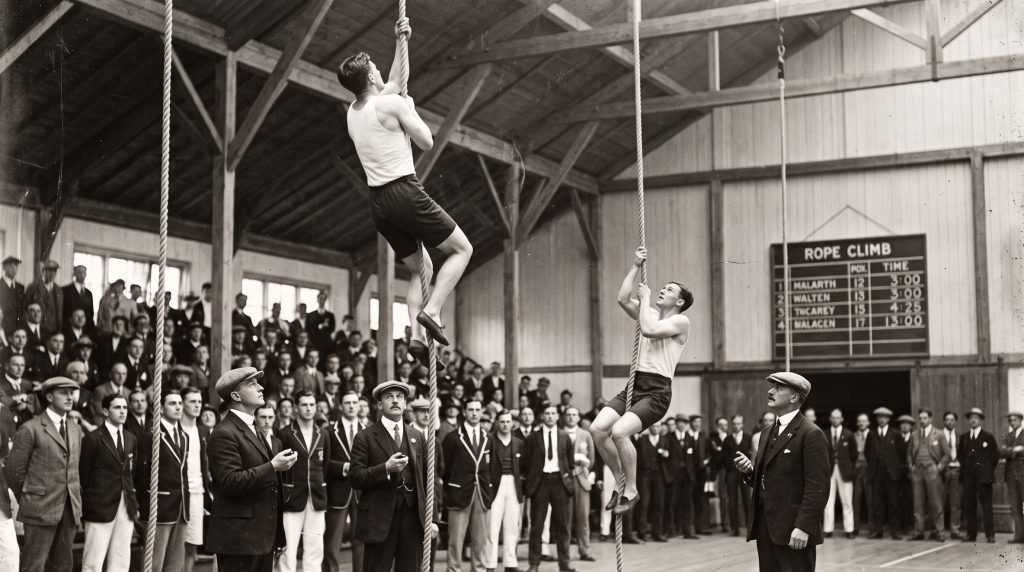
Forget pommel horses and floor routines. For several early Olympic Games, gymnastics also involved climbing a rope as fast as humanly possible. In the 1896 Athens Games, competitors started from the ground and tackled a roughly 14 meter vertical rope, with their performance judged on both how high they climbed and, for those who reached the top, their time and style. Later versions became a much purer speed test. By 1932, athletes had three attempts to climb an 8 meter rope, with the fastest ascent deciding the medals. In Los Angeles, Benny Bass won gold by reaching the top in just 6.7 seconds.
The sport had all the ingredients of an Olympic event designed during a very enthusiastic gym class. Athletes began from a seated position and had to haul themselves upward using their arms and upper body, although they could kick their legs while climbing. The 1896 rope was so long that several competitors simply gave up once it became obvious they were not catching the leaders. Then came 1924, when 22 climbers earned perfect style scores, forcing officials to use climbing time to separate them. By 1932, the spectacle had become considerably more straightforward: climb the rope really fast, try not to look terrified, and hope the stopwatch likes you.
Rope climbing was not part of the program at every Games during this period. It appeared at the 1896, 1904, 1924 and 1932 Olympics, with no Olympic appearance in 1928, before vanishing permanently after Los Angeles. The main problem was that it had little international reach and was increasingly viewed as an old fashioned specialty rather than a core gymnastics event. At the 1932 Games, only five competitors from two countries entered, with the two Hungarian athletes reportedly unfamiliar with the discipline. After 1932, Olympic gymnastics was streamlined around the apparatus events that became the sport’s modern identity. Rope climbing was left hanging.
6. Motorboating (1908, London)
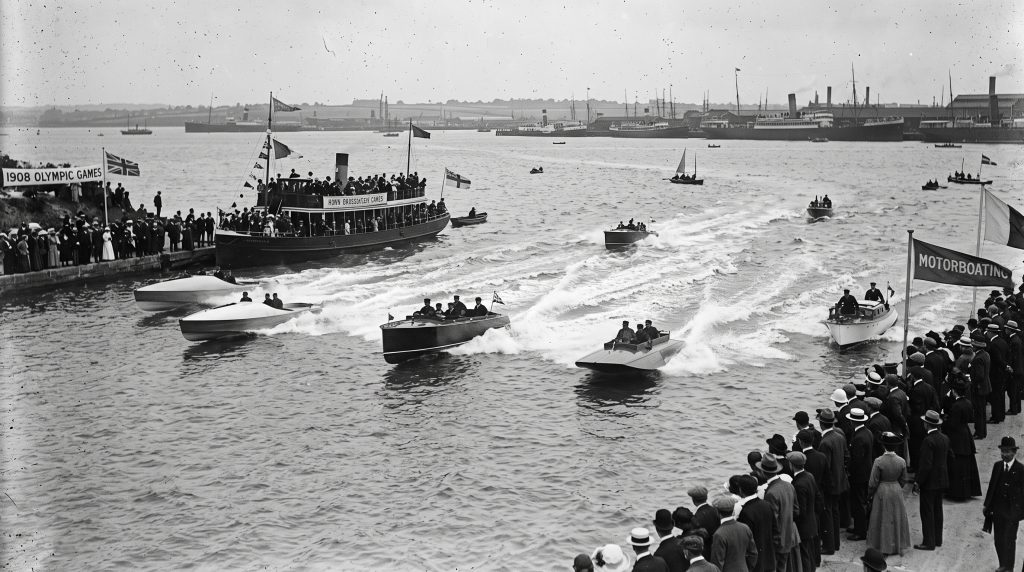
The 1908 London Olympics briefly turned the Games into something resembling a very expensive day at the marina. Motorboating featured three separate classes of powered racing boats, with competitors battling around a course on Southampton Water. Each Olympic race covered five laps of roughly eight nautical miles, meaning a punishing 40 nautical mile contest. The boats varied by class and size, with the A Class essentially wide open in terms of dimensions and power, while the smaller C Class was restricted to boats between 6.5 and 8 meters long.
This was less Chariots of Fire and more Fast & Furious: Southampton. The weather promptly demonstrated that engines cannot negotiate with the English Channel. The A Class race had to be abandoned after three laps because of adverse conditions, while mechanical failures and boats running aground added further amusement. In the C Class, Gyrinus won after its main rival, Sea Dog, suffered a hot bearing and failed to finish. The real punchline came when officials checked the results: across all three events, only one competitor or boat finished each race. It was technically racing, provided you were willing to redefine “racing” as “surviving until everyone else breaks.”
Motorboating never returned to the Olympic program after London 1908, and it is easy to see why. The events attracted just 14 participants from two countries, while the combination of brutal weather, mechanical breakdowns and tiny fields hardly screamed global Olympic success. There was also a more fundamental problem: motorboating was powered by engines rather than human athletic effort. For decades afterward, the Olympic Charter explicitly excluded sports whose performance depended essentially on mechanical propulsion. Although that wording has since been removed, motorboating remains absent from the Games, leaving its one and only Olympic appearance as a gloriously noisy footnote in sporting history.
5. Tug of War (1900–1920)
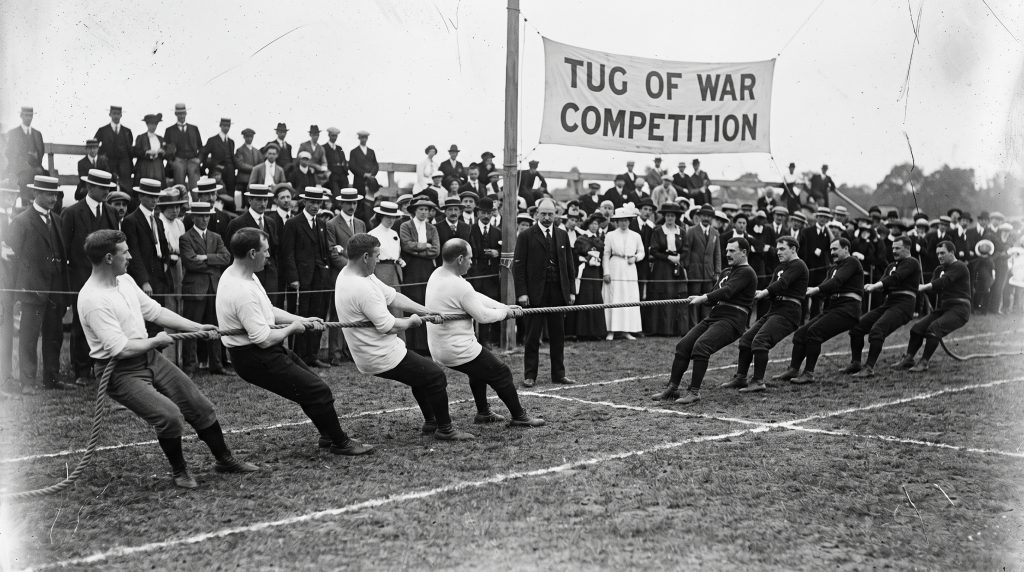
Tug of war might sound like something that belongs at a school sports day rather than the Olympic Games, but it was a medal event for five Olympics between 1900 and 1920. Teams of eight competitors lined up on opposite ends of a heavy rope and attempted to drag their opponents across a marked distance. In the early Games, the rules varied, but the basic objective remained wonderfully uncomplicated: plant your feet, lean back, pull like your life depends on it, and make the other team move. The event was contested as part of athletics, rather than as a separate sport.
Olympic tug of war produced exactly the sort of nonsense you would expect when national pride is attached to a rope. The 1908 final became particularly memorable when the British team, representing London City Police, defeated an American team after a dispute over footwear. The Americans complained that the British competitors were wearing heavy police boots, while the British argued that the shoes were perfectly legal. The Americans withdrew rather than continue, leaving Britain with the gold and a controversy over whether apparently regulation footwear could qualify as a tactical weapon. Even stranger, the 1900 Games saw mixed nationality club teams competing, including one that combined Danish and Swedish athletes. Apparently, international sporting unity was easier when everyone was pulling in the same direction.
Tug of war made its final Olympic appearance at the 1920 Antwerp Games. It was then removed from the program ahead of the 1924 Paris Olympics as part of a broader effort to streamline athletics and reduce the number of events. The sport itself did not disappear, continuing in various national and international competitions, but its Olympic career was over. Its downfall was not a lack of spectacle or competitive drama. Quite the opposite. The IOC simply decided that a Games increasingly focused on standardized track and field events had little room for what was essentially the world’s most prestigious group effort at moving a rope.
4. Pistol Dueling (1906, 1908)
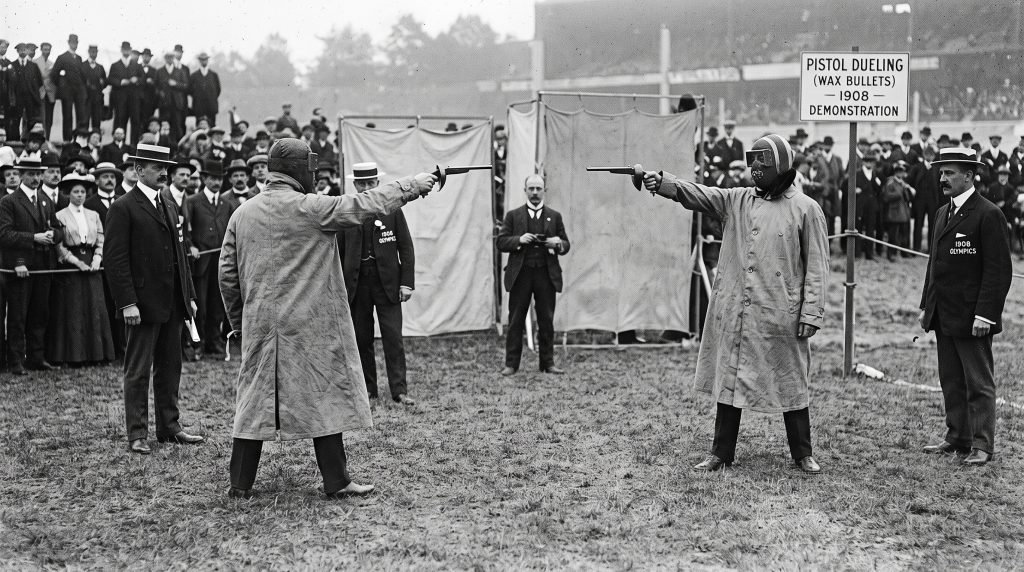
Olympic pistol dueling really did involve firing a weapon at another human being, although the reality was slightly less lethal than the name suggests. The sport grew out of French attempts to create a bloodless version of the traditional duel, using specially designed pistols that fired wax bullets. Competitors wore heavy protective clothing, metal helmets with thick glass face shields and hand guards, then stood apart and fired on command. There is, however, an important historical wrinkle: at the 1906 Intercalated Games, the official dueling pistol events involved shooting at human shaped plaster targets rather than people. The famous human versus human wax bullet duels were demonstrated in London in 1908 alongside the Olympic Games, rather than being an official medal event.
The sight of two men in what looked like medieval beekeeper armor calmly trying to shoot each other with pistols was undoubtedly spectacular. The rules added another layer of theatrical absurdity. Shooters held their pistols at their sides until the command to fire, then had only a few seconds to raise, aim and shoot. The wax ammunition was designed to be non lethal, but “non lethal” did not mean “pleasant.” The projectiles could still cause painful injuries, while the protective equipment offered only so much reassurance. The 1908 version attracted competitors from several countries and even produced a winning French team, but its association with the Olympic spectacle was largely that of a contemporary exhibition rather than a recognized Olympic championship.
Technically, the IOC did not ban pistol dueling because the human target version never became an official Olympic medal sport in the first place. The 1906 target shooting events disappeared from the Olympic program, while the 1908 wax bullet dueling demonstration did not return. The sport itself continued briefly in France, Britain and the United States before fading after the First World War, when the romantic culture of gentlemanly dueling looked considerably less charming in a world that had just experienced industrialized warfare. Pistol dueling therefore became one of Olympic history’s strangest near misses: it managed to get remarkably close to being an Olympic sport without ever properly earning the title.
3. 200m Swimming Obstacle Race (1900, Paris)
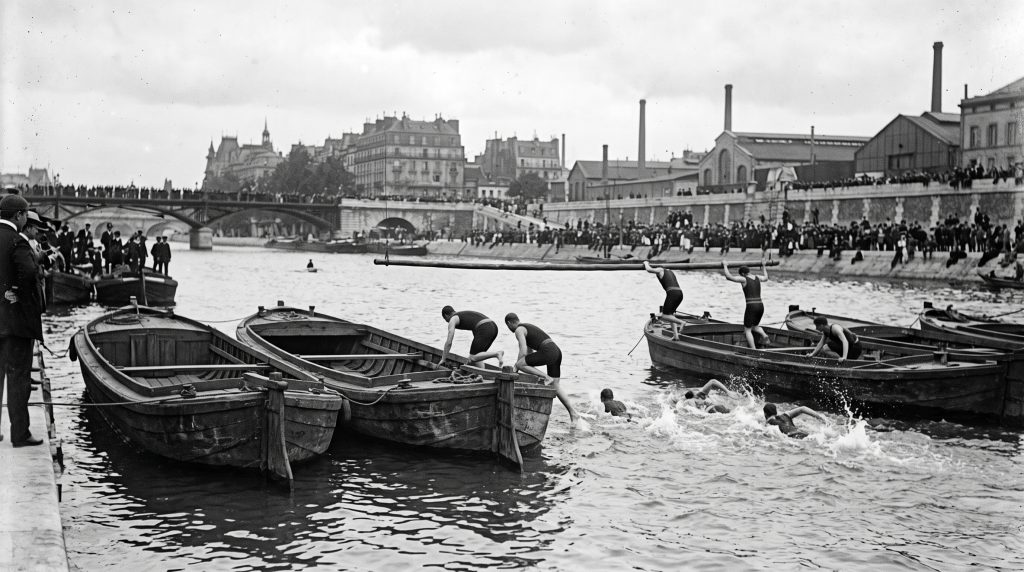
Forget swimming neatly from one end of a pool to the other. The 200m Swimming Obstacle Race at the 1900 Paris Olympics turned the Seine into an aquatic assault course. Competitors first swam to a pole, climbed over it, then reached a row of boats and scrambled across them. After that, they had to dive back into the river and swim underneath another row of boats before completing the final stretch to the finish. Twelve athletes from four countries took part, making this less conventional swimming and more waterborne obstacle course.
The entire event took place in the River Seine, where athletes had to contend with currents, river traffic and conditions that were a world away from the controlled Olympic pools of today. The obstacles transformed a straightforward swimming race into a bizarre combination of sprinting, climbing and underwater maneuvering. Fred Lane of Australia mastered the madness, winning the event in 2:38.4 and beating Austria’s Otto Wahle by just 1.6 seconds. Lane’s victory was historically significant too, as he is recognized as Australia’s first Olympic swimmer.
The event lasted exactly one Olympic Games. After making its sole appearance in Paris in 1900, the 200m obstacle race was dropped and never returned. There was no dramatic IOC ban. Instead, it simply failed to become a lasting part of the Olympic swimming program as the sport moved toward standardized racing events. Modern competitive swimming eventually settled on clearly defined strokes, distances and pools, leaving this gloriously strange combination of swimming and boat climbing as a one-off Olympic curiosity.
2. Plunge for Distance (1904, St. Louis)
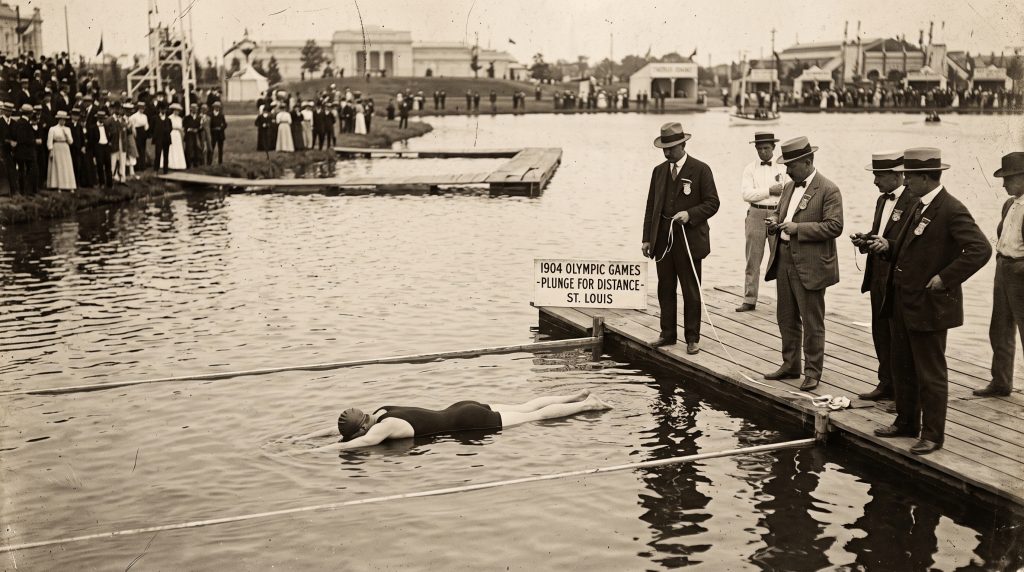
The Plunge for Distance was basically an underwater long jump, except there was one tiny catch: once athletes hit the water, they were not allowed to swim. Competitors made a standing dive from a stationary platform and then had to remain completely motionless, allowing the momentum from the plunge to carry them through the water. They had up to 60 seconds before the attempt ended, with the distance measured from the starting point to where they finally surfaced or stopped. At the 1904 St. Louis Olympics, five American competitors took part.
Calling this an athletic event required a fairly generous definition of “athletic.” Once the dive was made, the competitor’s main responsibility was essentially to become a human torpedo and do absolutely nothing. Body shape and momentum could make a major difference, with heavier athletes generally having an advantage because they could glide farther after the initial plunge. The five competitors collectively turned the event into something resembling an underwater staring contest, although William Dickey at least produced a respectable winning distance of 62 feet 6 inches (19.05 meters). It was difficult to manufacture much suspense when the competitors were literally forbidden from moving.
The Plunge for Distance had exactly one Olympic appearance, at St. Louis in 1904, and was never included again. History records lists it as an event held only once, with all five competitors coming from the United States. The sport itself was already losing popularity in swimming competitions, and contemporary criticism mocked it for rewarding inertia rather than athletic skill. Once Olympic swimming began settling around events involving actual swimming, there was little room for a competition whose winning strategy was essentially “jump in and become an iceberg.”
1. Live Pigeon Shooting (1900, Paris)
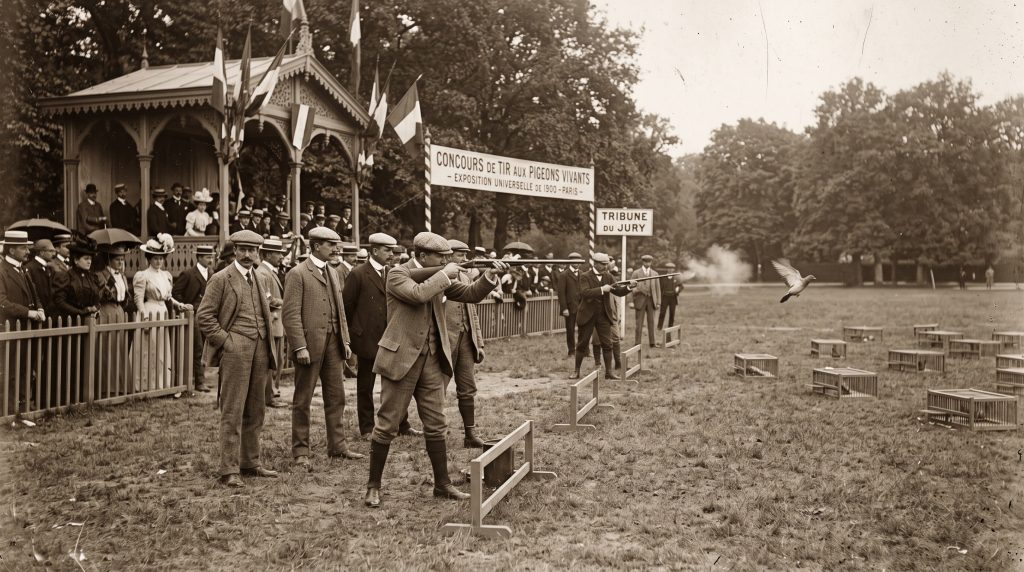
The name is about as subtle as the sport itself. At the 1900 Paris Olympics, shooters competed in live pigeon shooting, taking aim at real birds released from a trap at roughly 27 meters. Each shooter fired at one bird per round, and missing two birds meant elimination in the main Grand Prix event. The competition continued until only one shooter remained, making accuracy rather more consequential than your average clay pigeon contest. Belgian shooter Léon de Lunden won the main event after hitting 21 birds.
This was not exactly the wholesome family spectacle Olympic organizers were hoping to create. The birds were released into the air and shot for real, producing a contest that was both extremely straightforward and extraordinarily grim. The main event featured 52 shooters from eight countries, while a second live pigeon competition later in the Games attracted another six competitors. Unlike modern shooting events, there was no harmless clay target shattering into the sky. The target was an actual animal, and the whole thing took place at a dedicated pigeon shooting venue in Paris’s Bois de Boulogne.
Here’s where the popular story needs a little fact checking. Live pigeon shooting was indeed a one time Olympic oddity, but it was classified as an Olympic non medal event, rather than an official medal sport. There is also no solid evidence that the IOC immediately removed it because of public outrage, nor was it simply “replaced” by clay pigeon shooting. In fact, trap shooting was already contested at the same 1900 Games. Live pigeon shooting simply disappeared from the Olympic program after Paris, while trap shooting evolved into the far less horrifying target sport we know today. The Olympic movement eventually left the pigeons alone, which was probably the least controversial decision anyone made in Paris that summer.
The Legacy of the Early Experimental Olympics
The Olympic Games have come a long way from the days when athletes could compete by shooting pigeons, climbing ropes, or simply floating underwater. Many of these bizarre Olympic sports reflected the sporting culture of their time, but most eventually gave way to more standardized events with broader international appeal.
A couple of honorable mentions deserve a nod too: croquet, which appeared at the 1900 Paris Games, and hot air ballooning, also contested in Paris that same year as a non medal event.
Now it’s your turn: Which of these erased Olympic sports do you think deserves a comeback? Or is there one you are perfectly happy to leave buried in Olympic history?