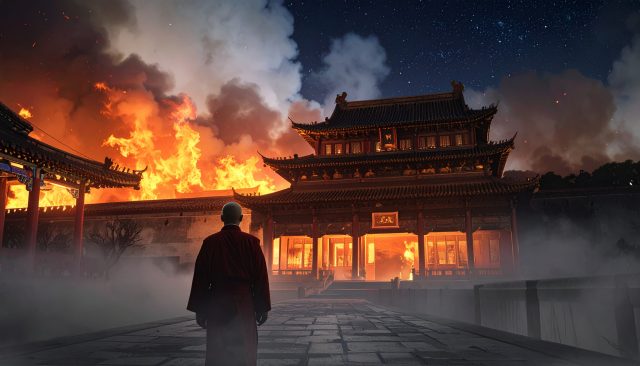

A palace burns. An emperor disappears. No body is ever confirmed. Did Emperor Jianwen really die, or did he escape into history’s shadows?
In the summer of 1402, the gates of Nanjing were thrown open, bringing a violent end to the three-year Jingnan civil war. As the rebel forces of Zhu Di (the future Yongle Emperor) breached the imperial city, the central palace was engulfed in a massive inferno. Inside, the reigning 24-year-old Emperor Jianwen was officially presumed dead.
The victorious uncle quickly claimed the throne, displayed three charred bodies as the emperor and his family, and systematically attempted to erase his nephew’s reign from Chinese history.
But the rumors began almost before the embers cooled.
Whispers swept across the Ming dynasty that the young emperor had utilized a secret escape route, shaved his head, and vanished into the vast network of Chinese monasteries.
More than six centuries later, the “Monk Emperor” remains one of Asia’s greatest historical cold cases. Here are ten compelling historical clues that suggest Emperor Jianwen did not die in the flames that night.
10. The Charred Bodies Were Completely Unrecognizable
Following the devastating fire, Yongle’s officials quickly presented three badly burned corpses, claiming they were Emperor Jianwen, Empress Ma, and their eldest son.
However, the bodies were charred entirely beyond recognition.
In an era deeply obsessed with ancestral rituals and absolute proof of succession, the rapid, unquestioned acceptance of these unidentifiable remains was highly suspicious. Without modern forensics, it was impossible to verify who had actually perished, providing the perfect cover for a staged death.
9. The Legend of the “Red Decree” Iron Box
According to persistent Ming folklore—which was eventually recorded in later historical texts—Jianwen’s grandfather, the founding Hongwu Emperor, foresaw future palace treachery.
Legend states he left Jianwen a sealed iron box to be opened only in a moment of absolute disaster.
When the palace caught fire, Jianwen allegedly opened it to find three monk’s robes, razors, folding hats, and a detailed map of the city’s underground drainage networks.
Whether literal truth or romanticized myth, the prevalence of this story proves that the Chinese public never bought the official narrative of his fiery death.
8. Yongle’s Ruthless Historical Erasure
If Jianwen was truly dead and no longer a threat, the new Yongle Emperor’s subsequent actions were intensely paranoid. He didn’t just claim the throne; he initiated a brutal campaign of historical erasure.
Yongle ordered all records of the Jianwen era destroyed, officially struck the reign name from the imperial calendar, and backdated documents to make it seem as though his own reign began immediately after his father’s.
This extreme, systematic purging suggests Yongle knew his nephew was still alive and actively sought to destroy the psychological legitimacy of his existence.
7. The Monastic Disguise Was the Ultimate Cover
Escaping the palace was only half the battle; surviving in a highly surveyed empire was another. But disguising himself as a wandering Buddhist monk was a stroke of tactical genius.
Ming China possessed thousands of remote temples and monasteries, creating a vast, decentralized network where transient holy men could move freely without drawing suspicion.
By shaving his head and donning simple robes, the former “Son of Heaven” could completely disappear into the poorest, most anonymous caste of society.
6. The Covert Domestic Manhunts Led by Hu Ying
Shortly after taking power, the Yongle Emperor dispatched a trusted official named Hu Ying on a bizarre, decades-long mission.
Officially, Hu Ying was tasked with traveling across the empire to search for a legendary “Taoist immortal.” However, modern historians almost universally agree this was a thinly veiled cover for a massive, covert manhunt to track down Jianwen.
Hu Ying spent over ten years combing through remote provinces and interviewing monks. This was an expense of state resources that makes no sense unless the emperor knew his nephew was still breathing.
5. The Mysterious Monks of Yunnan Province
During Hu Ying’s extensive searches, historical records note several instances of monks in the southern, mountainous province of Yunnan being brought in for intense questioning.
Yunnan was a known stronghold for Ming loyalists and the perfect geographical hideout.
These mysterious monks displayed a highly unusual level of refinement, spoke with upper-class courtly accents, and possessed an intimate knowledge of Nanjing palace protocol.
While none were officially executed as the missing emperor, the persistent interrogations in this specific region highlight the paranoia of the throne.
4. The True Purpose of Admiral Zheng He’s Treasure Fleets
Perhaps the most famous maritime expeditions in history, Admiral Zheng He’s massive “Treasure Fleets” traveled as far as Africa in the early 15th century.
While officially launched to establish trade routes and display Ming power, the official History of Ming specifically notes that Yongle suspected Jianwen had fled overseas.
Funding an unprecedented armada of 300 ships to scour the ports of Southeast Asia, Sumatra, and Malacca provided the perfect cover for a highly militarized, international search party hunting for a deposed king.
3. The Lack of an Imperial Tomb
Even when emperors were murdered or overthrown, victorious usurpers typically provided them with a modest royal tomb to appease the ancestors and legitimize the transition of power.
Jianwen was given no such honor.
He was entirely excluded from the Ming tombs, and the charred remains found in the palace were buried with the meager rites of a minor prince, not a sovereign.
This glaring lack of an imperial resting place suggests that Yongle himself wasn’t entirely convinced the ashes belonged to his rival.
2. The 1440 Arrest of an Imperial Imposter
The mystery violently resurfaced decades later in 1440, long after Yongle had died. An elderly monk in the Guangxi province openly claimed to be the missing Emperor Jianwen.
He was immediately arrested and transported to the new capital in Beijing for intense interrogation. The monk reportedly knew highly classified, intimate details about the layout of the old Nanjing palace.
While the government eventually declared him a fraudulent imposter named Yang Yingxiang and imprisoned him until his death, the event proved how potent the ghost of Jianwen remained to the ruling class.
1. The Dynasty’s Eventual, Tacit Admission
For nearly two centuries, discussing the fate of Emperor Jianwen was a dangerous political taboo.
However, in 1595, the Wanli Emperor finally restored Jianwen’s reign name to the historical record. By the time the Qing dynasty later wrote the official Ming history, they explicitly included the narrative of his escape as a valid historical possibility.
The fact that the dynasty itself ultimately softened its stance and allowed the escape legend to enter the official historical canon is the most glaring clue that the 1402 fire was a successful cover-up.
Conclusion
The fall of Emperor Jianwen remains one of the most intriguing and heavily debated mysteries of the Ming dynasty.
The narrative seems almost too cinematic: a burning palace, a vanished ruler, and a usurping uncle who spends the rest of his life anxiously hunting ghosts.
While official history initially dictated that the story ended in the ashes of Nanjing, the sheer scale of the Yongle Emperor’s subsequent cover-ups—from erasing calendars to launching massive armadas—tells a very different story.
Sometimes, history is written to reveal the truth. But in the case of China’s vanished emperor, history was aggressively rewritten to bury a man who simply refused to die.