
We love movies. We quote them, rewatch them, and emotionally invest in them… but we also happily ignore the fact that half of what happens on screen would collapse instantly under real-world logic.
That’s because Hollywood runs on shortcuts, exaggeration, and pure narrative convenience. It has to… otherwise every dramatic moment would be interrupted by things like awkward silences, spilled coffee, buffering security footage, and someone circling the block for parking for 45 minutes. But when you bring these cinematic habits into real life, they stop being exciting and start being completely unhinged.
Grab your impossibly perfect morning hair and your mysteriously empty coffee cup. Here are 10 hilarious movie tropes that make absolutely zero sense in the real world.
1. The “I’m Late!” Breakfast Buffet
A Five-Star Feast at Dawn
You know this scene. Every. Single. Time.
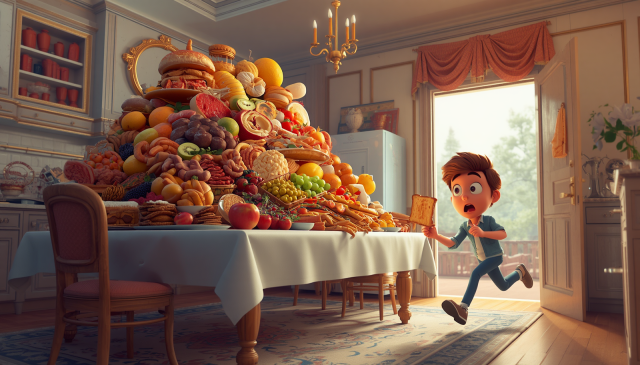
The camera glides into a spotless suburban kitchen where a parent has apparently been awake since the previous evening. Covering the table is a breakfast worthy of a five-star hotel: towering stacks of pancakes dripping with syrup, perfectly crisp bacon, fluffy scrambled eggs, waffles, fresh-cut fruit, muffins, yogurt parfaits, hash browns, and somehow a crystal pitcher filled with freshly squeezed orange juice. Nobody looks stressed. Nobody’s hair is messy. Nobody’s questioning why a family of four suddenly has enough food to cater a wedding brunch.
Then the teenager thunders downstairs with one backpack strap hanging off a shoulder, grabs a single piece of completely dry toast, shouts, “I’m late!” and disappears before anyone can ask how they’re late when they spent five uninterrupted minutes chatting in the kitchen. The parents simply smile as several pounds of untouched breakfast slowly cool into room temperature.
Apparently, this happens every weekday.
A Cold Pop-Tart Over the Sink
Meanwhile, back on Planet Earth, Tuesday morning is a survival challenge.
Mom’s trying to find her car keys. Dad’s wondering why nobody replaced the empty milk carton. The teenager insists they told everyone about the school project due today, which they absolutely did not. Someone’s frantically searching for one missing shoe while the dog is suspiciously chewing something important.
That enormous breakfast? It isn’t happening unless it’s Christmas morning or someone has accidentally invited the entire extended family over.
If anyone spent an hour making pancakes, eggs, bacon, fruit, and fresh orange juice before work and school, only for a teenager to grab one lonely slice of toast and sprint out the door, there would be a high-speed pursuit involving a spatula and some very creative parenting vocabulary.
Real weekday breakfasts are considerably less cinematic. They’re a granola bar eaten in traffic, cereal inhaled in under three minutes, or a cold Pop-Tart consumed while standing over the kitchen sink because nobody has time to sit down.
Hollywood wants us to believe families casually abandon gourmet feasts every morning. In reality, we’re celebrating if everyone leaves the house wearing matching shoes.
2. The Phantom Goodbye
The Badass, Wordless Hang-Up
Movies have somehow convinced us that phone calls operate under a completely different set of social rules.
The detective gets the crucial clue. The president receives terrifying news. The best friend finally delivers the emotional pep talk. One character says something dramatic like, “Meet me at the warehouse in ten minutes,” or, “You know what you have to do.”
Click.
That’s it.
No “bye.” No “see you.” No “thanks for calling.” They just hang up like the other person has spontaneously vanished into another dimension. Even more incredible, the person on the other end never calls back asking, “Uh… did we get disconnected?”
Apparently, everyone in Movie Land has collectively agreed that conversations simply self-destruct the second the important information has been delivered.
Starting an Unforgivable Family Feud
Try ending a real phone call like that.
Your friend says, “So, I’ll pick you up at seven”
Click.
Within fifteen seconds, your phone is vibrating with an incoming call.
“Hello? Did your phone die?”
“No.”
“…Then why did you hang up on me?”
Because in real life, ending a conversation without some variation of “bye” isn’t efficient, it’s borderline hostile. It’s the conversational equivalent of making eye contact with someone, nodding once, and walking away while they’re still talking.
Real phone calls have their own bizarre ritual that nobody questions. You don’t just say goodbye once, you negotiate your exit like you’re leaving an international peace summit.
“Okay, sounds good.”
“Yep.”
“Alright, bye.”
“Love you too.”
“Okay, bye-bye.”
“Yep.”
“See you.”
“Bye.”
“…You hung up first, right?”
Hollywood skips all of this because it wastes precious screen time. The rest of us know that without the sacred goodbye sequence, you’re not ending a conversation… you’re starting an argument.
3. The Baguette Rule of Groceries
Perfectly Staged, Aesthetically Pleasing Produce
Has anyone in Hollywood ever actually been grocery shopping?
Because according to movies, every single trip to the supermarket produces the exact same shopping haul. Two brown paper bags overflowing with a suspiciously photogenic collection of groceries. A gigantic, completely unwrapped baguette is sticking out at a dramatic angle like it’s auditioning for Best Supporting Bread. Next to it is an absurdly leafy bunch of celery, perhaps a few carrots with the tops still attached, and maybe a bouquet of flowers because apparently everyone impulse-buys fresh lilies alongside frozen peas.
The bags are carried effortlessly in one arm while the character casually unlocks the front door, flirts with the neighbor, and delivers witty dialogue. Nothing falls out. Nothing tears. The baguette remains perfectly positioned, proudly announcing to the audience, “This person buys groceries.”
It’s less of a shopping trip and more of a produce-themed fashion statement.
The 14-Tote-Bag Circulation Cutter
Meanwhile, actual grocery shopping is an endurance sport.
First, there are no charming brown paper bags. There are approximately fourteen reusable canvas bags that weigh the same as a compact car, all cutting off circulation to your fingers because you refuse to make two trips from the car.
Inside those bags is complete chaos. A watermelon is crushing the tortilla chips. The bread has somehow ended up underneath a frozen pizza. A bottle of laundry detergent is threatening to leak onto the bananas. You have absolutely no memory of buying six different sauces, yet here they are.
And where’s the majestic baguette?
If you did buy one, it’s either sticking awkwardly out of your trunk, snapped in half because it wouldn’t fit in the bag, or already being nibbled by someone who insisted they were “just having one bite” on the drive home.
Hollywood grocery bags are carefully arranged by prop departments to tell us, “This character shops for food.”
Real grocery bags tell a much different story: “I underestimated how much sparkling water weighs, and I’m one slippery driveway away from losing a carton of eggs.”
4. The Defying-Physics Coffee Cup
Gesticulating with Gravity-Defying Lattes
The scene usually starts outside a trendy café.
A character walks out carrying what is supposedly a piping-hot, extra-large coffee. Seconds later, they’re waving it around like it’s a conductor’s baton. They punctuate every sentence by dramatically pointing the cup at people, casually tossing it from one hand to the other, or holding it between two fingers as though it weighs less than a TV remote.
Sometimes they even sprint across the street, jump into a taxi, or slam the cup onto a desk without spilling so much as a single drop.
Nobody ever flinches from the heat. Nobody takes that cautious first sip that inevitably burns the roof of your mouth. The lid never pops off. The coffee never sloshes. It behaves less like a beverage and more like an empty movie prop.
Because, of course, it usually is.
Scalding Everyone in a Three-Foot Radius
Now try that with an actual full venti latte.
The moment you make your first dramatic hand gesture, the coffee immediately reminds you that gravity exists. Half the drink splashes onto the lid, dribbles down the side of the cup, and somehow ends up on your white shirt.
That casual one-handed flourish? Congratulations. You’ve just baptized your car’s center console in espresso.
Real people carry hot coffee like they’re transporting unstable nuclear material. One hand grips the cup. The other hovers underneath for emotional support. Every step is carefully calculated to avoid creating a tiny cappuccino tsunami.
And if someone starts talking with their hands while holding a fresh coffee, everyone nearby instinctively takes one step back.
Hollywood wants us to believe these cups are filled with steaming caffeine.
We know the truth.
Those cups are emptier than a movie parking lot in downtown Manhattan. There’s no other explanation for how someone can wave a “full” coffee around like they’re conducting an orchestra without wearing half of it home.
5. The Magical “Enhance” Button
Enhancing 144p to 4K Instantly
Every crime movie has that scene.
The detectives gather around a monitor displaying security footage that looks like it was recorded through a potato during an earthquake. Somewhere in the distance, roughly 300 yards away, a car the size of a postage stamp speeds past for exactly half a second.
“No way we can identify it,” mutters the rookie.
That’s when the resident tech genius rolls their chair into frame, cracks their knuckles, and begins furiously mashing random keys at 200 words per minute.
“Let’s enhance.”
The blurry blob instantly transforms into pristine 8K footage. They zoom into the driver’s side mirror. Then into the reflection of a puddle. Then into the reflection inside the reflection. Suddenly, the suspect’s face is crystal clear, the license plate is perfectly readable, and somehow the software has also identified a fingerprint on the steering wheel.
Case closed.
Apparently, Hollywood believes pixels are like nesting dolls, just keep opening them until you find the truth.
Trying to Identify a Smudge
Back in the real world, that’s… not how cameras work.
If security footage is blurry, zooming in doesn’t magically reveal hidden details. It just gives you a much larger, much uglier blur. Congratulations, you’ve successfully enhanced the fuzziness.
Real investigators spend hours staring at footage that raises more questions than answers.
“Is that a blue sedan?”
“…Could be.”
“Is that even a car?”
“…Might be an SUV.”
“Is that the suspect?”
“I honestly can’t tell if that’s a person, a mailbox, or a golden retriever wearing a hoodie.”
The license plate is six pixels wide. The suspect’s face resembles modern art. And after zooming in six times, you’ve learned exactly one thing: compression artifacts have feelings too.
Hollywood treats surveillance footage like it’s a save file containing unlimited hidden information waiting to be unlocked with the magic word “enhance.”
Reality is far less cooperative. Sometimes the most accurate forensic conclusion is, “Yep… something definitely moved through the frame at approximately 8:17 p.m.”
Not quite the dramatic breakthrough the movies promised.
6. The “It’s Not What It Looks Like!” Stammer
The Agonizing Inability to Speak
This trope is basically relationship sabotage on autopilot.
A character walks into a room at the worst possible moment, someone is half-dressed, someone is on top of someone else (to fix a necklace, obviously), or there’s an extremely innocent situation that looks wildly incriminating from exactly one angle.
And instead of speaking like a normal human being with access to language, the accused immediately short-circuits.
“Wait! No! I can explain!”
Pause.
“It’s not what it looks like!”
Another pause.
“I swear, it’s not. Please just listen!”
By this point, the innocent person has already sprinted out of the room in emotional distress, possibly boarding a train to another continent, because apparently no one in movies is required to stay for a full sentence of clarification.
Three minutes later, after several increasingly panicked variations of “please listen,” the explanation is finally delivered… but only to an empty hallway.
Clearing It Up in Four Seconds
In reality, humans are far less theatrical and far more survival-oriented.
Someone walks in and sees a suspicious scene.
Before the misunderstanding can even form, the explanation is already out:
“Before you say anything, Susan tripped, spilled water on my lap, and now it looks like I had an accident. I promise I’m not peeing my pants.”
Done. Case closed. Emotional crisis averted.
Or even shorter:
“It’s water. She spilled it. I’m fine.”
Because in real life, nobody is wasting 90 seconds dramatically repeating variations of the same sentence while their relationship collapses in slow motion.
We are, if anything, aggressively efficient when our dignity is on the line.
The only time real humans hesitate is when they’re trying to find the least embarrassing phrasing possible, not when they’re auditioning for a soap opera monologue.
Hollywood insists we freeze up like malfunctioning robots in moments of misunderstanding.
Reality is much simpler: we talk fast, we over-explain immediately, and we absolutely refuse to let someone leave the room thinking we wet ourselves without contesting it within the first three seconds.
7. The Miracle Manhattan Parking Spot
Front-Door VIP Access on Demand
City driving in movies is basically a curated fantasy of urban convenience.
A character is navigating the “chaotic” streets of New York, London, or Chicago… except traffic is oddly polite, taxis part like Moses at the Red Sea, and every intersection feels suspiciously underpopulated for one of the busiest cities on Earth.
Then it happens.
Right in front of the destination, be it a courthouse, a penthouse apartment, or a dramatic rooftop confrontation, there it is: the Holy Grail of urban infrastructure.
A completely empty parking spot.
Not just any spot, either. It’s directly in front of the entrance. Perfectly aligned. No parallel parking struggle. No tight squeeze. No suspiciously aggressive honking from nearby drivers who absolutely saw it first.
The character casually pulls in like they’ve been personally guided by the Parking Gods, shuts off the engine, and walks in without even checking for alternate options.
It’s less parking and more cinematic destiny.
The 45-Minute Walk of Shame
Now back on Earth, where parking is a psychological endurance test.
You enter the city with hope. That hope dies within eight minutes.
You circle the block once. Then again. Then you start recognizing landmarks you’ve already passed, which is how you know you’re in a loop of suffering.
Every potential space is either:
- “Resident permit only”
- “Loading zone (enforced 24/7, emotionally and legally)”
- Or occupied by a car parked so confidently it feels personal
By minute 27, you’re bargaining with reality.
“Okay, I’ll take anything within a 12-minute walk.”
By minute 43, you’re considering abandoning your car permanently and starting a new life as a pedestrian in a less judgmental neighborhood.
Eventually, you surrender. You pay $50 (or its equivalent in emotional damage) for a parking garage that requires a maze-like descent, multiple turns, and a final existential walk back to the surface world.
And the “perfect spot right outside the building”?
That exists in movies, where traffic flows like water and parking obeys narrative convenience instead of the laws of supply, demand, and human despair.
8. The Hacking Keyboard Mash
Mashing Keys to Breach the Pentagon
Ah yes, the cinematic “cybersecurity breach,” where hacking is apparently just… aggressive typing.
A teenager in a dimly lit room, almost always wearing a hoodie they didn’t own three scenes ago. Sits down in front of a glowing monitor. The camera zooms in dramatically as they crack their knuckles like they’re about to enter a piano competition, except the prize is national security failure.
Then it begins.
They slam the keyboard like it owes them money. No pauses. No hesitation. No concern for readability, logic, or literally anything resembling real input. Just pure mechanical fury.
The screen responds accordingly: green code cascades down like digital rain, windows explode open, alarms start blaring in systems that apparently announce their own defeat, and firewalls politely step aside like, “Ah yes, please proceed.”
Within 12 seconds:
“I’m in.”
No mouse. No commands. No authentication steps. Just vibes and keyboard violence.
Three Hours Googling a Syntax Error
In actual life, “hacking” looks like this:
You open your laptop.
You type something reasonable like a human being.
You get an error message that looks like it was written in ancient runes and mild contempt.
You Google the error.
You find a forum post from 2014 where someone asks the exact same question and receives a reply that just says, “works on my machine 👍” before disappearing forever.
You try three suggested fixes. Nothing works.
You discover you missed a semicolon.
One. Single. Semicolon.
Then you spend another hour convincing yourself the problem is definitely not the semicolon, try everything except the semicolon, and finally come back full circle to the semicolon like it personally betrayed you.
There is no dramatic green code rain. No instant system takeover. No confident declaration of “I’m in.”
Just you, staring at your screen, whispering threats at your own code while Stack Overflow judges you silently from the past.
9. The Flawless Morning Wake-Up
Immaculate Beach Waves at 7 AM
Morning in movies is a gentle, cinematic experience designed to make the rest of us feel personally attacked.
Sunlight filters perfectly through sheer curtains that definitely never get dusty. A character slowly wakes up in a bed that looks like it’s never been slept in, stretching in slow motion like they’re in a wellness ad for people who have never experienced deadlines.
Their hair? Effortless beach waves. Not a single strand misbehaving. Their face? Somehow already camera-ready. Mascara intact, skin glowing, lips subtly glossed like they just casually maintained a full beauty routine in their sleep.
They sit up, smile at absolutely nothing, and sip water from a glass that was mysteriously placed on the bedside table by what can only be described as cinematic benevolence.
No alarm clock panic. No existential dread. Just calm, glowing serenity as if mornings are a sponsored experience.
The Shipwreck Survivor Look
Now, in reality, waking up is less “soft-focus beauty montage” and more “emergency excavation.”
You open your eyes and immediately regret it. One eye refuses to cooperate. The other is trying its best but clearly lost the negotiation overnight.
Your hair has formed a shape that can only be described as “architectural incident.” Pillow creases are stamped across your face like you slept against a waffle iron. Your mouth is dry enough to qualify as a desert biome.
There is no elegant stretching. There is a slow, creaky roll out of bed followed by a moment of silent bargaining with gravity.
And the idea of waking up with mascara and lip gloss already perfectly applied? That requires either:
- Advanced sleep-beauty wizardry
- Or a level of commitment to makeup hygiene that borders on suspicious
Most mornings are spent trying to locate your dignity, your phone, and possibly your sense of time… all while looking like you survived a low-budget disaster film titled “The Pillow Incident.”
Hollywood wakes up glowing.
We wake up negotiating peace treaties with our own reflection.
10. The Cough of Impending Doom
The Dainty Sputter of Imminent Demise
No trope does dramatic foreshadowing quite like The One Strategic Cough™.
A distinguished character, usually a stern businessman, Victorian aristocrat, or emotionally unavailable father figure that delivers dialogue with impeccable control. Everything is composed. Polished. Controlled.
Then it happens.
A single cough.
Not loud. Not messy. Just one delicate, perfectly timed cough into a handkerchief like they’ve rehearsed it for maximum narrative impact.
Everyone in the room pauses. Nobody asks follow-up questions. The music subtly shifts into “something is terribly wrong” mode.
We, the audience, immediately understand: this character has approximately 2.5 scenes left before they dramatically collapse, reveal a tragic diagnosis, or die in a rain-soaked farewell while clutching a photograph.
That cough isn’t a cough.
It’s a countdown timer.
Just Swallowing Water the Wrong Way
In reality, a single cough is never just a single cough.
It is the opening act of a full-scale internal rebellion.
You swallow your own spit wrong for half a second and suddenly your body decides to escalate the situation to DEFCON 2.
What starts as a polite “ahem” immediately spirals into a five-minute negotiation with your windpipe. Your eyes water. Your dignity leaves the room. You try to recover by sipping water, which only makes everything worse.
Now you’re stuck in the worst possible scenario: trying to signal to everyone around you that you are not dying, while simultaneously performing the most suspicious coughing performance of your life.
People at the dinner table start asking:
“Are you okay?”
And you, between violent coughs, respond with:
“Yes—*I’m fine—*just—wrong pipe—”
Hollywood coughs once and gets a tragic backstory arc.
Real life coughs once and immediately turns into a group presentation titled: “Don’t worry, this is normal, I promise.”
Hollywood vs. Reality (And Why We Still Love It)
As ridiculous as these movie tropes are when you stop and think about them for more than half a second, the truth is we probably wouldn’t survive a version of cinema that followed real life too closely. Nobody wants a two-hour film of circling for parking, rereading error messages, or apologizing mid-cough between bites of a sandwich. The nonsense is kind of the point, it keeps everything fast, dramatic, and just believable enough that we don’t question it until later.
Now be honest, what did we miss? There are definitely more cinematic crimes against reality hiding out there. Drop your favorite hilariously inaccurate movie trope in the comments.
If you think modern movies are guilty of ridiculous tropes, wait until you see how many of them actually trace back to the silent film era. Take a look at how it all started in…