


Football matches may be decided by moments of genius, but championships are usually won on the tactical drawing board. Behind every dominant dynasty, revolutionary coach, and unforgettable team lies a formation that changed how the game was played. From aggressive pressing systems to possession-heavy masterpieces, football tactics have continuously evolved to solve new problems, exploit new spaces, and outthink the opposition. Individual talent can inspire greatness, but the right tactical system can redefine an entire era.
That evolution is exactly what this article explores. Redefining the modern era does not simply mean inventing a new lineup on paper — it means changing football’s entire tactical language. Over the last century, the sport has transformed from the chaotic attacking swarms of the 19th century into today’s hyper-structured systems built around pressing, positional play, and fluid movement. Along the way, iconic formations introduced revolutionary ideas like the sweeper, the False 9, the double pivot, and the inverted fullback. Many of the tactical trends dominating modern football today can trace their roots back decades.
Some formations disappeared. Others evolved. But all of them permanently changed the beautiful game.
Here are the 10 tactical blueprints that completely redefined modern football forever.
1. The Pyramid (2-3-5)
The Formation That Invented Modern Football
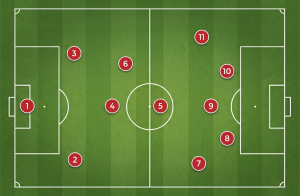
Long before football became a chess match of pressing traps, inverted fullbacks, and false nines, there was chaos. In the late 19th century, the sport resembled a giant schoolyard scrum more than the tactical spectacle we know today. Most teams simply packed players forward and hoped individual dribbling brilliance would overwhelm opponents. Defending was reactive, spacing barely existed, and structured teamwork was still in its infancy.
That changed with the arrival of the 2-3-5 formation, better known as The Pyramid.
At first glance, the shape looks absurd by modern standards: two defenders, three midfielders, and five attackers. But in its era, the Pyramid was revolutionary because it introduced something football had never truly seen before – positional organization. Instead of every player charging toward the ball, the formation divided the pitch into functional zones. The two fullbacks stayed deeper, the three halfbacks linked defense and attack, and the five forwards spread across the field to stretch opponents horizontally.
More importantly, the Pyramid helped establish the concept of passing football. Earlier teams relied heavily on dribbling runs, but the 2-3-5 encouraged combination play between inside forwards, wingers, and midfielders. The central halfback role, in particular, became the tactical ancestor of the modern defensive midfielder. Players were no longer just athletes; they were specialists with responsibilities tied to space and structure.
The formation also evolved alongside the offside rule changes of the 1920s, laying the groundwork for nearly every tactical system that followed. Even though later formations would add more defensive balance, many of football’s positional concepts were born directly from the Pyramid’s framework.
No team symbolizes the formation’s influence more than the early Scottish sides, especially the legendary Queen’s Park F.C. — whose emphasis on passing and movement shocked more direct English opponents. Internationally, Uruguay’s Olympic-winning sides of the 1920s and the early World Cup teams also refined the system into a fluid attacking machine.
The Pyramid’s true legacy is impossible to overstate. Every modern formation, whether it’s 4-3-3, 3-5-2, or 4-2-3-1 — traces part of its DNA back to this structure. It was football’s first real tactical blueprint, the moment the sport transformed from organized chaos into a strategic game of space, balance, and movement.
2. The W-M (3-2-2-3)
The First Great Tactical Counterattack Against Chaos
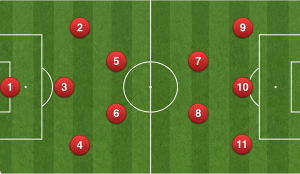
By the 1920s, football had a problem. The attacking freedom of the Pyramid system produced thrilling matches, but defenses were increasingly exposed. Then came a rule change that shook the sport: in 1925, the offside law was altered so attackers only needed two defenders between themselves and the goal instead of three. Overnight, scoring exploded across Europe. Defenders suddenly found themselves helpless against waves of forwards timing runs behind the back line.
Football needed a defensive revolution.
That revolution arrived in the form of the W-M formation.
Created and perfected by legendary Herbert Chapman at Arsenal F.C., the W-M reshaped the traditional 2-3-5 into a far more balanced structure. One of the midfield halfbacks dropped deeper into defense, turning the back line from two players into three. Meanwhile, the inside forwards moved slightly backward into creative linking roles between midfield and attack. On paper, the formation resembled the letters “W” and “M” when mapped vertically across the pitch, hence the name.
The tactical innovation was enormous.
For the first time, teams had a dedicated central defender whose primary job was stopping the opposition striker. This role eventually evolved into the modern center-back. The W-M also introduced clearer separation between defensive and attacking responsibilities, making football less chaotic and more strategically layered. Teams could now defend compactly and counterattack quickly rather than relying solely on relentless attacking numbers.
Equally important was the emergence of structured transitions. Instead of all players surging forward together, the W-M encouraged calculated movement through midfield channels. The two attacking midfielders became creative connectors, while wide forwards stretched defenses more intelligently. It was one of the earliest systems to truly value shape without sacrificing attacking threat.
Chapman’s Arsenal became the defining example of the system’s power during the 1930s, dominating English football with speed, organization, and ruthless efficiency. The formation spread rapidly across Europe and South America, influencing tactical thinking for decades. Even Brazil’s later systems and the defensive structures of Italian football borrowed heavily from its principles.
The W-M’s greatest legacy was psychological as much as tactical. It proved that football could be engineered. Managers no longer simply selected players and hoped for chemistry, they designed systems to solve specific strategic problems. In many ways, the W-M marked the birth of the modern football manager as a true tactician.
3. The Brazilian 4-2-4
The Formation That Turned Football Into Art
By the 1950s, football had become increasingly rigid. The W-M system brought defensive stability, but many teams had grown cautious and predictable. Attacks often felt mechanical, with slow build-ups and clearly defined positional roles limiting creativity. Coaches wanted balance, but the sport risked losing its spontaneity.
Then Brazil changed everything.
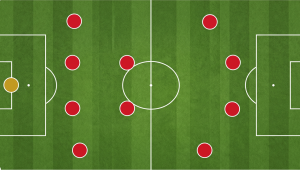
The 4-2-4 formation exploded onto the world stage as a daring solution to one central problem: how do you keep attacking flair without becoming defensively vulnerable? The answer was deceptively simple. Instead of relying on five forwards like the old Pyramid or heavily structured defensive lines like the W-M, the 4-2-4 created a more fluid balance between attack and shape.
The innovation began with the back line. Four defenders provided far greater defensive coverage than earlier systems, allowing fullbacks to manage wide areas more effectively. Ahead of them sat two hardworking midfielders responsible for both shielding the defense and launching attacks. But the real magic happened up front.
The front four stretched defenses in ways opponents had never experienced before. Wingers stayed wide, central forwards interchanged positions, and attackers rotated dynamically instead of remaining fixed in place. This movement created space for dribblers, quick passing combinations, and devastating counterattacks. The formation demanded technically gifted players who could attack with freedom while still contributing collectively.
Most importantly, the 4-2-4 blurred positional boundaries. Attackers dropped deeper, midfielders surged forward, and defenders became involved in build-up play. It was one of the first systems to embrace fluidity as a weapon rather than treating strict structure as sacred.
The formation reached legendary status through Brazil national football team during the 1958 and 1970 World Cups under managers like Vicente Feola and with icons such as Pelé, Garrincha, and Mário Zagallo. Brazil’s dazzling style showed the world that tactical discipline and expressive football could coexist.
The 4-2-4 also became the tactical ancestor of modern attacking systems. Variations of it eventually evolved into the 4-3-3 and 4-2-3-1 formations that dominate today’s game. Its emphasis on width, fluid movement, and technical versatility permanently changed how teams approached attacking football.
More than just a formation, the 4-2-4 represented a philosophical shift. Football was no longer only about organization or defensive balance. It could also be beautiful.
4. Catenaccio (1-3-3-3 / 1-4-3-2)
The Defensive System That Made Winning an Art Form
By the late 1950s and early 1960s, football’s attacking revolution was in full swing. Systems like the 4-2-4 had unleashed waves of fluid movement and technical brilliance, but many teams struggled to contain increasingly dangerous forwards. Defenses were often exposed in transition, and tactical organization still lagged behind attacking innovation.
Enter Catenaccio — football’s most infamous defensive revolution.
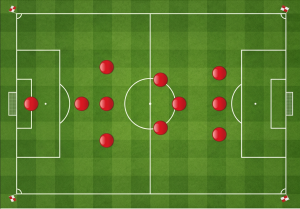
The word itself means “door bolt” in Italian, an appropriate name for a system designed to shut opponents out completely. While earlier tactical systems focused on balance, Catenaccio prioritized defensive security above all else. But contrary to its reputation, it was not simply about parking players behind the ball. It was a deeply calculated structure built around discipline, anticipation, and devastating counterattacks.
The defining innovation was the introduction of the sweeper, or libero. Positioned behind the main defensive line, this player had freedom to read danger, cover teammates, and intercept attacks before they became fatal. Unlike traditional defenders locked into strict marking duties, the sweeper operated as a tactical problem-solver, cleaning up mistakes and launching counters from deep positions.
The system also relied heavily on man-marking. Defenders followed opponents aggressively across the pitch, disrupting rhythm and denying creative players time on the ball. Meanwhile, midfielders worked tirelessly to compress space, forcing teams into crowded central areas where attacks could be smothered.
But Catenaccio’s true brilliance came after the ball was won.
Instead of slow possession play, teams exploded forward through rapid counterattacks. A quick vertical pass could instantly transform defense into attack. This made the system both frustrating and deadly: opponents dominated possession, only to be punished by ruthless efficiency.
No figure is more associated with Catenaccio than Helenio Herrera and his legendary Inter Milan side of the 1960s, often called Grande Inter. Herrera perfected the balance between defensive organization and lethal transitions, leading Inter to multiple European Cups while terrifying opponents with their tactical precision.
The influence of Catenaccio spread far beyond Italy. Its emphasis on compact defending, transitional football, and tactical discipline shaped generations of coaches. Modern low-block systems, counterattacking football, and even today’s organized pressing structures all borrow elements from its philosophy.
Perhaps its greatest legacy is psychological. Catenaccio forced football to confront an uncomfortable truth: dominating possession did not guarantee victory. Intelligence, structure, and defensive mastery could be just as powerful as attacking flair.
For better or worse, it changed the sport forever.
5. Total Football (4-3-3)
The System Where Every Player Could Become Everything
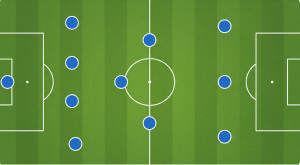
Football had become increasingly specialized by the late 1960s. Systems like Catenaccio divided players into rigid roles: defenders defended, midfielders distributed, and attackers finished chances. Tactical discipline was growing, but creativity often felt constrained. Teams became predictable because players were expected to stay in carefully assigned zones.
Then came a tactical philosophy that shattered positional boundaries entirely.
Total Football was not just a formation — it was a complete reimagining of how space, movement, and intelligence could control a football match. Built around a fluid 4-3-3 structure, the system allowed virtually any outfield player to interchange positions seamlessly during the game. Defenders could attack, forwards could defend, and midfielders became the connective tissue holding the entire machine together.
The central idea was revolutionary: the formation itself mattered less than the occupation of space.
When one player vacated an area, another instantly filled it. A fullback charging forward would be covered by a midfielder. A striker dropping deep would open space for a winger to attack centrally. This constant rotation disoriented opponents, making traditional man-marking nearly impossible. Teams facing Total Football often found themselves chasing shadows as players drifted fluidly across the pitch.
The system also introduced a more aggressive style of pressing. Instead of retreating defensively after losing possession, players immediately swarmed the ball to win it back high up the field. Compact spacing between lines ensured the team moved almost as a single organism, squeezing opponents into mistakes while maintaining attacking pressure.
At the heart of the philosophy was technical intelligence. Every player needed exceptional awareness, passing ability, and tactical understanding. The goalkeeper participated in build-up play, defenders initiated attacks, and attackers contributed defensively. It demanded footballers who could think as quickly as they moved.
No team embodied Total Football more famously than AFC Ajax and the Netherlands national football team under visionary coach Rinus Michels. On the pitch, the philosophy reached artistic perfection through Johan Cruyff, whose intelligence and positional freedom became the system’s living symbol.
The impact on modern football was enormous. Total Football directly influenced positional play, pressing systems, and possession-based football seen today. Coaches like Pep Guardiola, Jürgen Klopp, and countless others inherited concepts born from Michels and Cruyff’s ideas.
Modern football’s obsession with versatility, pressing, ball retention, and tactical fluidity all trace back to Total Football. It transformed players from static specialists into dynamic thinkers and proved that movement itself could become a weapon.
More than any formation before it, Total Football made the entire pitch feel alive.
6. The Wing-Back Era (3-5-2)
The Formation That Turned the Sidelines Into Battlegrounds
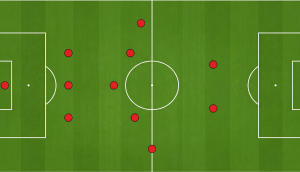
By the late 1980s and early 1990s, football was evolving again. Traditional four-man defenses were beginning to feel predictable, while classic wingers were slowly disappearing from many systems. Teams wanted greater control in midfield without sacrificing width, but balancing both had become a tactical headache. Packing central areas often left the flanks exposed, while using wide attackers could weaken midfield dominance.
The solution arrived in the form of the 3-5-2, a system that completely reinvented the importance of wide players.
At the heart of the formation was the rise of the wing-back, one of the most demanding roles football had ever seen. Unlike traditional fullbacks or wingers, wing-backs were expected to do both jobs simultaneously. They attacked like wide forwards, defended like fullbacks, and often covered the entire length of the pitch for ninety minutes.
The tactical structure was deceptively clever.
Three central defenders provided defensive security and allowed one player to step forward aggressively when needed. In midfield, the extra central player gave teams numerical superiority, helping them dominate possession and control transitions. Meanwhile, the wing-backs stretched the field horizontally, becoming the primary source of width in attack.
This balance created enormous tactical flexibility. Teams could defend compactly with five at the back, then instantly transform into an aggressive attacking shape when the wing-backs surged forward. The formation also encouraged overloads in midfield, making it especially effective against traditional 4-4-2 systems that struggled to match numbers centrally.
The 3-5-2 also accelerated the evolution of modern positional versatility. Center-backs became more comfortable on the ball, midfielders had to cover greater tactical ground, and wing-backs evolved into hybrid athletes capable of influencing every phase of play.
One of the defining examples of the system came through Carlos Bilardo and the Argentina national football team that won the 1986 FIFA World Cup. Later, Italian football embraced the formation heavily, with coaches like Marcello Lippi using it to devastating effect at Juventus F.C.. In the Premier League era, managers such as Antonio Conte modernized the system even further, turning wing-backs into the engines of elite pressing and counterattacking football.
The legacy of the 3-5-2 is everywhere in the modern game. Variations like the 3-4-3 and 3-4-2-1 dominate contemporary tactics, especially among teams seeking flexibility between attack and defense. More importantly, the formation permanently changed how football viewed wide spaces. The flanks were no longer secondary channels, they became tactical highways capable of deciding matches.
The Wing-Back Era proved that sometimes the most important players on the pitch are the ones running endlessly up and down its edges.
7. Sacchi’s 4-4-2
The System That Turned Pressing Into a Science
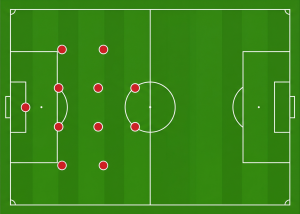
In the mid-1980s, much of European football remained divided between rigid defensive systems and individual brilliance. Teams either sat deep in organized blocks or relied heavily on star players to improvise moments of magic. Defensive structures like Catenaccio still influenced Italian football, but matches could become slow, reactive, and overly dependent on man-marking.
Then Arrigo Sacchi arrived and completely changed the way teams defended.
Sacchi’s version of the 4-4-2 at AC Milan was not revolutionary because of the formation itself — 4-4-2 already existed. The revolution was how the system functioned. Instead of defending space passively or assigning players to strict man-marking duties, Sacchi built a compact, synchronized machine where every player moved together as part of a collective structure.
The innovation centered around pressing, spacing, and coordination.
Sacchi demanded that his team defend aggressively as a unit. When the ball moved, the entire team shifted together almost mechanically, compressing space and suffocating opponents. Defensive lines pushed high up the pitch, reducing the room attackers had to operate. Rather than chasing individual players everywhere, Milan defended zones intelligently and triggered coordinated pressing traps to force mistakes.
This approach required extraordinary discipline. The distance between defenders, midfielders, and forwards had to remain compact at all times. If one player pressed, everyone else adjusted instantly. The back line stepped forward together, midfielders closed passing lanes, and strikers became the first defenders.
Perhaps most importantly, Sacchi transformed defending from a reactive task into an attacking weapon.
His Milan side could win possession high up the field and launch devastating attacks before opponents had time to reorganize. The system also demanded technically intelligent defenders comfortable holding a high line, which was risky in an era when many teams still defended deep.
The iconic Milan team of the late 1980s and early 1990s became one of the greatest club sides ever assembled. With players like Franco Baresi, Paolo Maldini, Ruud Gullit, and Marco van Basten, Milan dominated Europe through a blend of tactical precision and relentless intensity.
Sacchi’s influence on modern football is enormous. His ideas laid the foundation for contemporary pressing systems, zonal defending, and compact team structures.
The genius of Sacchi’s 4-4-2 was that it proved football was not just about talent or formation diagrams. It was about collective movement, synchronized pressure, and controlling space with near-military precision.
In many ways, modern pressing football begins with him.
8. The Double Pivot (4-2-3-1)
The Formation That Perfected Modern Balance
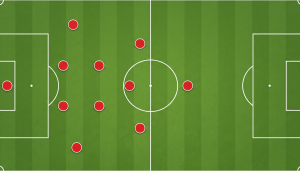
By the late 1990s and early 2000s, football had become faster, more technical, and far more transitional. Traditional 4-4-2 systems were beginning to struggle against teams flooding midfield with extra playmakers. Managers needed a shape that could protect the defense, dominate possession, and still support fluid attacking football without leaving dangerous gaps in transition.
The answer was the rise of the 4-2-3-1 — the formation that would eventually dominate the modern era.
At the heart of the system was its defining innovation: the double pivot. Instead of relying on a single defensive midfielder, two deeper midfielders worked together in tandem. One could sit deeper and shield the defense, while the other progressed the ball forward or drifted wider to support build-up play. This partnership created far greater stability against counterattacks while also improving ball circulation under pressure.
The tactical flexibility was enormous.
Ahead of the pivot sat an attacking trio capable of rotating constantly behind a lone striker. Wide attackers could drift centrally, the central attacking midfielder could become a playmaker or secondary forward, and fullbacks were encouraged to overlap aggressively. The shape could morph fluidly between defensive solidity and attacking overloads without losing structural balance.
Perhaps the biggest advantage of the 4-2-3-1 was how effectively it controlled midfield space. Against older two-man midfields, teams using the system often enjoyed numerical superiority in central areas, making possession easier to maintain while limiting opposition creativity.
The formation also accelerated the evolution of several modern roles. The attacking midfielder became a dynamic creator operating between the lines, while holding midfielders evolved into deep-lying playmakers capable of dictating tempo from deeper positions. Wide attackers increasingly functioned as inverted forwards rather than traditional touchline wingers.
No national side embodied the system’s potential more memorably than the Spain national football team during their era of dominance between 2008 and 2012. At club level, managers like José Mourinho used the 4-2-3-1 to devastating effect with Real Madrid CF and Chelsea F.C., combining defensive structure with explosive counterattacking transitions.
The system became especially influential because it could accommodate nearly every style of football. Possession-heavy teams, pressing sides, and counterattacking clubs all found ways to adapt it to their philosophy. By the 2010s, it had become arguably the default formation of elite football.
Its legacy remains everywhere today. Modern tactical systems still rely heavily on double pivots, hybrid attacking midfielders, and flexible positional rotations that the 4-2-3-1 popularized on a global scale.
More than any other formation, the Double Pivot Era mastered football’s eternal challenge: balancing creativity with control.
9. Tiki-Taka and the False 9 (4-3-3 / 4-1-4-1)
The System That Made the Ball the Ultimate Weapon
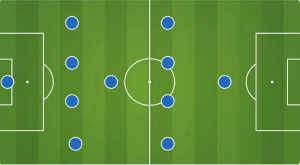
By the late 2000s, football had become increasingly physical and transition-focused. Many elite teams relied on pace, direct attacks, and defensive compactness to overwhelm opponents. Even possession-based football often revolved around crossing to powerful strikers or breaking quickly after turnovers. Traditional center-forwards still acted as fixed reference points at the top of the attack.
Then came a tactical philosophy that completely dismantled conventional ideas about space, possession, and even what a striker was supposed to be.
Tiki-Taka was built around obsessive ball retention, positional superiority, and relentless movement. Using variations of a fluid 4-3-3 or 4-1-4-1, the system aimed to dominate matches not through physicality, but through control of the ball itself. Opponents were exhausted mentally as much as physically, forced to chase endless passing triangles while struggling to regain possession.
The defining tactical innovation was the rise of the False 9.
Instead of staying high up the pitch like a traditional striker, the central forward dropped deep into midfield areas. This movement created a nightmare for defenders. If center-backs followed the False 9, they left dangerous gaps behind them for wingers and midfield runners to exploit. If they stayed in position, the False 9 gained time and space to dictate play between the lines.
The role demanded extraordinary intelligence and technical ability. The False 9 was simultaneously a playmaker, forward, and spatial manipulator. Rather than simply scoring goals, the position destabilized entire defensive systems.
The formation also perfected positional play. Every player occupied carefully calculated zones designed to create constant passing options and overloads. Fullbacks pushed high and wide, midfielders rotated seamlessly, and quick short passing maintained territorial control. Pressing immediately after losing possession — often called counter-pressing — ensured opponents rarely escaped pressure long enough to launch attacks.
No team embodied this philosophy more completely than FC Barcelona under Pep Guardiola between 2008 and 2012. With players like Lionel Messi, Xavi, and Andrés Iniesta, Barcelona produced one of the most dominant and aesthetically admired footballing eras ever seen.
Internationally, the Spain national football team adapted similar principles to win back-to-back European Championships and the 2010 FIFA World Cup, proving the philosophy could conquer football at every level.
The influence of Tiki-Taka and the False 9 permanently reshaped the modern game. Strikers became more versatile, defenders were forced to improve technically, and pressing after possession loss became a standard tactical principle across elite football.
More importantly, the system redefined control itself. Teams no longer needed to defend constantly if they simply refused to give the ball away.
For a brief period, football looked less like a sport and more like choreography.
10. The Modern Box Midfield (3-2-4-1)
The Formation That Turned Every Phase Into Controlled Chaos
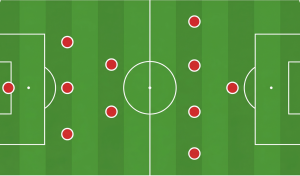
In the late 2010s and early 2020s, football had entered an era of extreme tactical sophistication. Pressing systems were more coordinated than ever, defensive blocks were compact and intelligent, and nearly every elite team understood positional play principles. Traditional formations still existed on paper, but matches increasingly became fluid battles of spacing, overloads, and transitional control.
Managers needed a new solution to one growing problem: how do you dominate central spaces against highly organized pressing systems without sacrificing attacking width or defensive stability?
The answer was the rise of the modern box midfield.
Usually appearing as a 3-2-4-1 in possession, the system is less a fixed formation and more a constantly shifting structure. Its defining feature is the “box” created in central midfield: two deeper players sit behind two advanced midfielders, forming a square that overwhelms opponents centrally. This setup creates multiple passing angles, numerical superiority, and better resistance against pressing traps.
The innovation largely came through positional flexibility.
Fullbacks no longer simply overlapped on the wings. Instead, many inverted into midfield alongside a holding player, helping create the deeper part of the box. Center-backs spread wider during build-up, wingers held touchline width high up the pitch, and attacking midfielders floated between defensive lines searching for pockets of space.
The result is a system built for modern control.
The box midfield allows teams to dominate possession while still maintaining strong rest-defense structures against counterattacks. If possession is lost, enough players remain centrally positioned to immediately press and recover the ball. At the same time, the shape creates devastating overloads between midfield and defensive lines, where creative players can receive the ball facing goal.
The system also accelerated the rise of hybrid footballers. Fullbacks became midfielders, center-backs became playmakers, and attacking players were expected to rotate constantly rather than remain fixed in one lane. Tactical intelligence and spatial awareness became just as important as physical attributes.
No manager is more associated with the modern box midfield than Pep Guardiola, particularly during his later years with Manchester City F.C.. Players like John Stones stepping into midfield from defense perfectly symbolized the system’s fluidity. Variations of the shape have also appeared in teams coached by Mikel Arteta, Xabi Alonso, and other tacticians heavily influenced by positional play.
The legacy of the 3-2-4-1 is still unfolding, but its impact is already enormous. It reflects modern football’s shift away from rigid formations toward adaptable structures that change constantly depending on possession, pressure, and space.
More than any tactical system before it, the modern box midfield treats football as a living puzzle — one where positions are temporary, movement is constant, and control comes from owning the center of the pitch.
Football Never Stops Reinventing Itself
One of the most fascinating truths about football tactics is that the game moves in cycles. Systems that once seemed outdated often return decades later in modernized forms. The aggressive positional rotations of today’s 3-2-4-1 structures echo ideas first seen in the old W-M system. Wing-backs from the 1990s resemble the attacking wide players of the Pyramid era. Even the False 9 has roots in earlier forwards who dropped deep to create space.
The sport constantly evolves, but it also constantly remembers.
Every tactical revolution in football has emerged because someone found a new solution to an old problem: how to create space, control possession, stop great attackers, or overwhelm organized defenses. From the Pyramid’s first attempt at structure to the fluid chaos of modern positional play, each formation reshaped not only how teams lined up, but how football itself was understood.
And the next revolution may already be happening.
Modern football is increasingly moving toward position-less systems where players are valued less for fixed roles and more for intelligence, versatility, and athletic adaptability. Defenders now step into midfield, strikers create instead of simply finishing, and formations can change five times during a single attacking sequence. As data analysis, pressing intensity, and player athleticism continue to evolve, future tactics may become even more fluid and unpredictable.
But no matter how advanced the sport becomes, the core idea remains timeless: football is a game of space, movement, and innovation.
Which formation do you think had the biggest impact on the modern game? Was it the defensive discipline of Catenaccio, the artistry of Total Football, or the positional dominance of Tiki-Taka? Let us know in the comments below.