


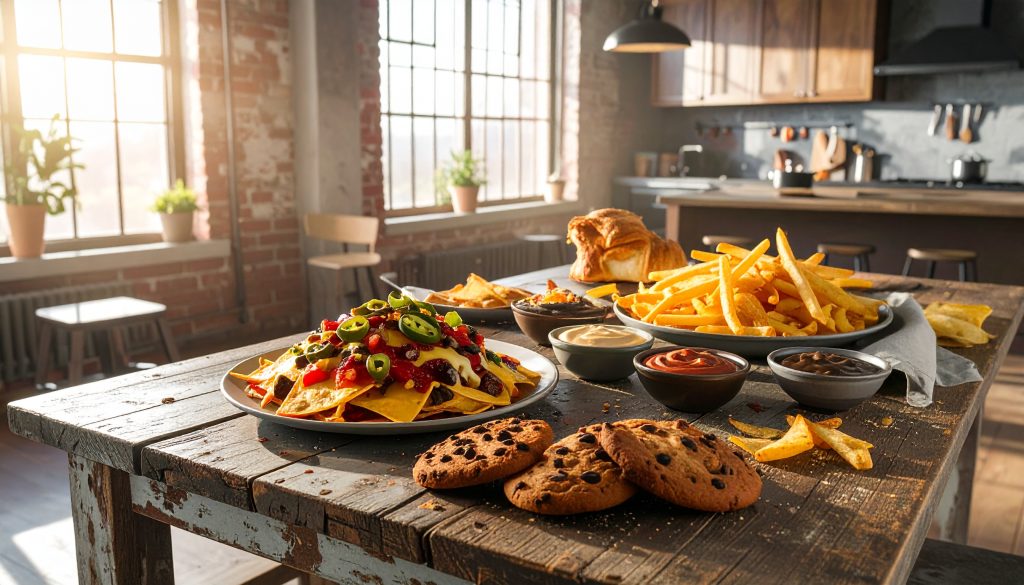
We all love comfort food. Whether it’s a bubbling plate of mac and cheese, a slice of pizza, or a handful of crispy fries—meals that instantly evoke warmth, nostalgia, and a sense of safety. These are the dishes we turn to on long days, late nights, and family gatherings, assuming they’ve always belonged in our kitchens just as they are today.
But beneath their familiar, comforting surface lies a far more unexpected truth: many of the world’s most popular comfort foods have origins that are chaotic, accidental, politically charged, or born from survival and improvisation rather than deliberate culinary design. What we now consider everyday staples were often shaped by migration, hardship, cultural exchange, and sheer chance.
In this article, we explore how these iconic dishes evolved across centuries and continents, revealing the surprising events that transformed humble meals into global favorites. Here are 10 surprising origins behind the world’s most popular comfort foods, and the remarkable histories hiding in plain sight.
10. Pizza: The “Disgusting” Food of the Poor
Today, pizza is one of the world’s most beloved comfort foods, but its origins were far less glamorous. In the late 18th and early 19th centuries, pizza was considered a cheap street food eaten mainly by the working-class poor of Naples, Italy. Wealthier visitors often described it as unsanitary and even “disgusting” because it was sold openly on the streets and topped with whatever ingredients struggling families could afford.
Everything changed in 1889 when pizzaiolo Raffaele Esposito reportedly created a pizza featuring tomatoes, mozzarella, and basil to honor Queen Margherita of Savoy. The colors mirrored the Italian flag, and the dish helped transform pizza’s reputation from peasant fare to a source of national pride. While historians debate some details of the story, the connection between pizza and Queen Margherita remains one of food history’s most famous legends.
Ironically, the comfort food now served in upscale restaurants and delivered worldwide was once viewed as a symbol of poverty. Its journey from Naples’ crowded streets to global menus shows how quickly culinary perceptions can change when the right people start paying attention.
9. Fried Chicken: A Convergence of Cultures
Few comfort foods have a history as rich and layered as fried chicken. While many people associate it with the American South, its origins are actually the result of several culinary traditions coming together. Scottish immigrants brought a practice of frying chicken in fat, while West African cooks contributed sophisticated seasoning techniques and methods that produced deeper flavor and crispier results.
During the 18th and 19th centuries, these traditions merged in the American South, creating a dish that was both practical and delicious. Chickens were relatively inexpensive to raise, and frying offered a quick way to prepare a satisfying meal. Over time, regional spices, family recipes, and local cooking styles transformed fried chicken into a cornerstone of Southern cuisine.
What makes the story remarkable is that one of the world’s most popular comfort foods wasn’t invented by a single person or culture. Instead, fried chicken became iconic because it represents a culinary exchange shaped by migration, adaptation, and resilience. Every crispy bite carries traces of multiple traditions that helped create a global favorite.
8. Ketchup: A Fermented Fish Sauce
It may be hard to believe while squeezing it onto fries, but ketchup did not begin as a tomato-based condiment. Its distant ancestor was likely kê-tsiap, a fermented fish sauce used in China and Southeast Asia as early as the 17th century. Salty, pungent, and packed with umami, it looked and tasted nothing like the sweet red sauce we know today.
European traders encountered the condiment during their voyages through Asia and brought versions of it back home. Because authentic ingredients were difficult to obtain, cooks began experimenting with substitutes, creating recipes based on mushrooms, walnuts, oysters, and anchovies. For decades, “ketchup” referred to a wide range of savory sauces rather than a single standardized product.
The tomato version emerged in the early 19th century and gradually became dominant, especially after advances in food preservation and commercial production. By the late 1800s, companies such as Heinz helped popularize the sweeter, tomato-based recipe that conquered global markets. One of today’s most familiar comfort-food companions therefore traces its roots not to tomatoes, but to a centuries-old fermented fish sauce.
7. Macaroni and Cheese: Perfected by an Enslaved Chef
Macaroni and cheese is often linked to Thomas Jefferson, who encountered pasta dishes during his travels in Europe and helped popularize them in the United States. But one of the most important figures in the dish’s American story was James Hemings, the enslaved chef who accompanied Jefferson to France in the 1780s. There, Hemings received formal culinary training and mastered techniques that few American cooks possessed at the time.
Upon returning to the United States, Hemings prepared elegant versions of macaroni baked with cheese at Jefferson’s household. His expertise transformed what was then a relatively unfamiliar European dish into a standout feature at high-profile dinners. Guests were impressed by the rich combination of pasta and cheese, helping spread its reputation among America’s elite.
For generations, Hemings’ contributions were largely overlooked while Jefferson received much of the credit. Modern historians have worked to restore recognition to James Hemings, whose culinary skill played a crucial role in establishing macaroni and cheese in American food culture. The beloved comfort food’s history is therefore not just about ingredients, it’s also about acknowledging the talented chef who helped perfect and popularize it.
6. Hamburgers: The Mongol Cavalry’s Rations
One of the most enduring stories about the hamburger traces its roots to the horsemen of the Mongol Empire under Genghis Khan in the 13th century. According to popular legend, Mongol cavalrymen carried minced meat beneath their saddles, tenderizing it during long rides and creating a convenient ration they could eat quickly between battles. While historians debate the accuracy of this tale, it helped inspire later stories about the origins of chopped-beef dishes in Europe.
A more documented link appears in the port city of Hamburg, Germany, where minced beef became a popular meal by the 19th century. German immigrants carried versions of the Hamburg steak to the United States, where cooks eventually began serving the seasoned beef patty between slices of bread for convenience. The result was a portable meal perfectly suited to an increasingly fast-paced industrial society.
The modern hamburger was therefore shaped by a mix of legend, migration, and innovation. Whether or not Mongol warriors truly created its earliest ancestor, the story highlights how one of the world’s ultimate comfort foods evolved from simple minced meat into a global culinary icon.
5. Chocolate Chip Cookies: A Happy Accident
The “happy accident” story is one of the most persistent food myths, but it isn’t accurate. Ruth Wakefield, owner of the Toll House Inn in Massachusetts during the 1930s, did not run out of ingredients or stumble into invention. As a trained dietitian and experienced chef, she deliberately created the chocolate chip cookie while developing a new dessert to serve alongside ice cream.
Wakefield intentionally chopped pieces of a Nestlé semi-sweet chocolate bar, expecting them to hold shape during baking and add texture contrast to her dough. The result was exactly what she planned: a cookie with soft, chewy dough and distinct chocolate pieces. Its popularity exploded, leading to a famous agreement where Nestlé printed her recipe on packaging in exchange for a lifetime supply of chocolate. Far from accidental, this was a calculated and highly successful culinary innovation.
4. Potato Chips: A Chef’s Petty Revenge
The famous “petty chef revenge” story behind potato chips is largely a myth. While George Speck (also known as George Crum) did work at the Moon’s Lake House in Saratoga Springs in the 1850s, there is no evidence he invented potato chips out of frustration with a picky customer, and he never even claimed to have done so himself.
In fact, thinly sliced, fried potatoes appeared in cookbooks long before Crum’s fame, including William Kitchiner’s 1817 cookbook The Cook’s Oracle. Crum’s real contribution was popularizing extremely thin, crisp versions served as “Saratoga Chips,” which became a regional specialty. Over time, the romanticized revenge narrative overshadowed the more ordinary truth: potato chips evolved gradually, and Crum helped refine and promote them, not invent them in a fit of culinary spite.
3. Croissants: An Austrian Victory Pastry
The croissant is often celebrated as a symbol of French baking, but its story likely begins in Austria, not France. A popular legend traces its origins to the 1683 Battle of Vienna, when bakers working before dawn supposedly heard Ottoman forces attempting to tunnel beneath the city walls. After the attack was repelled, the bakers are said to have created a crescent-shaped pastry inspired by the symbol on the Ottoman flag to commemorate the victory.
Whether the tale is entirely true remains a matter of debate, but historians agree that Austria had a long tradition of crescent-shaped pastries known as kipferl. These baked goods predated the modern croissant by centuries and were already a staple of Viennese cuisine. The pastry eventually made its way to France, where bakers refined it using laminated dough and generous amounts of butter.
The result was the flaky croissant we know today. Ironically, one of France’s most famous comfort foods owes much of its ancestry to Austrian baking traditions and a centuries-old military legend. It’s a reminder that even the most iconic national dishes often have surprisingly international roots.
2. French Fries: A Belgian Winter Substitute
French fries are a perfect example of how food history is often shaped by national pride as much as fact. A popular Belgian tradition claims the dish originated in rural areas along the Meuse River, where villagers fried small fish as a staple food. When the river froze during harsh winters, they allegedly sliced potatoes into fish-like shapes and fried those instead, creating an early version of what we now call fries.
However, this origin story is strongly disputed. French culinary historians argue that “pommes frites” were actually born in Paris, specifically among street vendors selling fried potato strips on the Pont Neuf in the late 18th century, just before the French Revolution. According to this view, the dish emerged as an urban street food rather than a rural winter substitute.
Today, both Belgium and France continue to claim ownership of the fry’s invention, and the true origin remains unresolved. What is clear, however, is that this humble comfort food sits at the center of one of Europe’s most enduring culinary rivalries.
1. Nachos: A Desperate Improvisation
Unlike many comfort foods whose origins are buried in centuries of legend, nachos can be traced to a specific person, place, and moment. In 1943, Ignacio “Nacho” Anaya was working at a restaurant in Piedras Negras, Mexico, near the Texas border, when a group of hungry customers arrived after the kitchen had already closed. With limited ingredients available, Anaya had to improvise.
He cut tortillas into triangles, fried them, topped them with shredded cheese and sliced jalapeños, and quickly heated the dish before serving it. The customers loved the snack and asked what it was called. Anaya reportedly replied, “Nacho’s Especiales,” a name that would eventually be shortened to simply “nachos.”
What makes the story remarkable is how ordinary the circumstances were. There was no royal banquet, ancient tradition, or carefully planned recipe, just a resourceful cook solving a problem on the spot. That moment of culinary improvisation created one of the world’s most recognizable comfort foods, proving that sometimes the best ideas emerge when there is no time to plan at all.
From Peasant Fare to Global Favorites
The next time you reach for a slice of pizza, a handful of chips, or a plate of mac and cheese, remember that these beloved comfort foods often began as accidents, survival strategies, or meals for ordinary people. Their surprising journeys through history prove that some of the world’s most iconic dishes emerged from necessity, creativity, and cultural exchange rather than careful planning.
Which of these food origins surprised you the most? Let us know in the comments, and share any other comfort foods with fascinating backstories that deserve a spot on this list!